Why a unit square has an un-fractionable diagonal
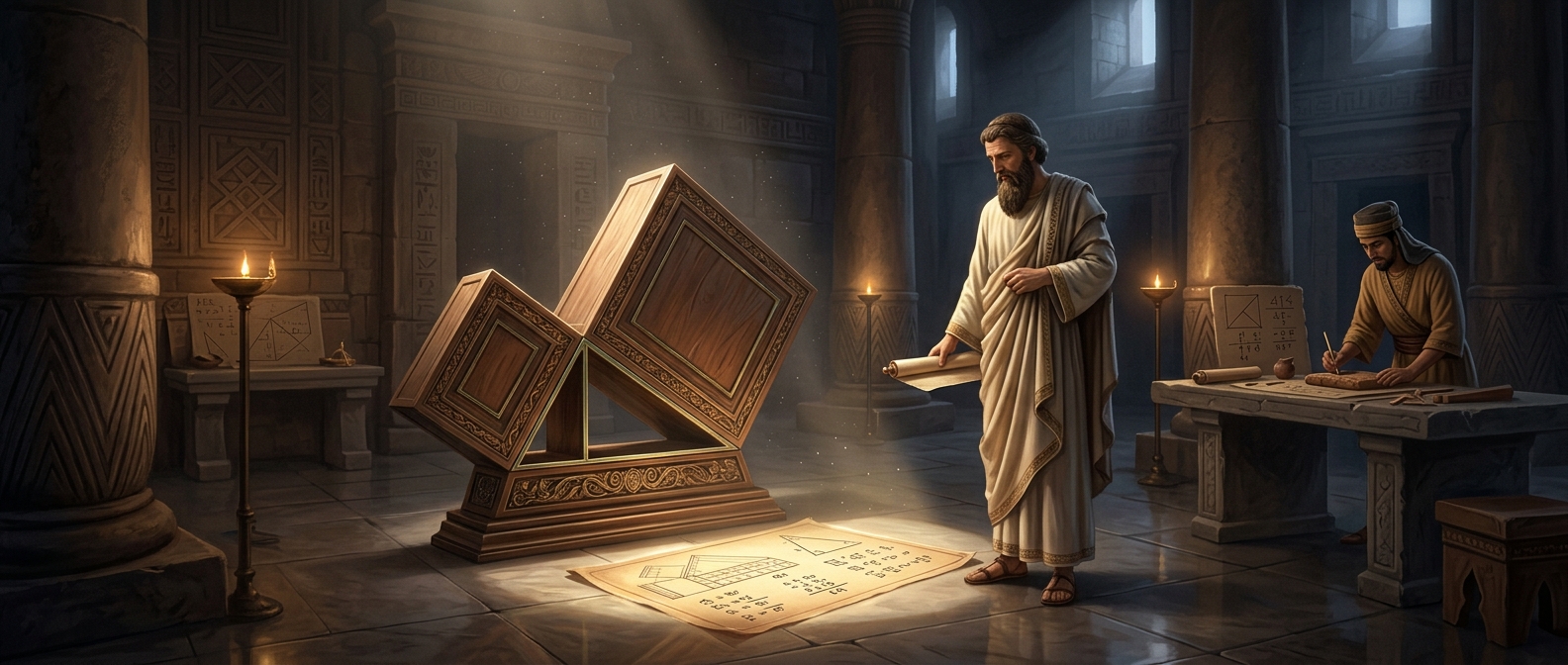
The square’s diagonal creates a number that cannot be written as one whole number divided by another. The right-triangle rule gives its length as √2, but the surprising part is not that its decimal goes on forever. Some fractions also have endlessly repeating decimal expansions. What makes √2 different is that its digits never settle into a repeating pattern—and no fraction equals it exactly.
The contradiction hidden in a fraction
Suppose √2 could be written as a fraction, reduced to its simplest form: a/b. Squaring both sides gives a² = 2b². That equation says a² is even, so a must be even too. Write a as twice another whole number, then substitute it back into the equation: b² must also be even, which means b is even.
But then both a and b share a factor of 2. That contradicts the assumption that the fraction was already reduced. No such fraction can exist. This is a proof by contradiction: assuming a fraction works leads to an impossibility.
Approximation is not the same as an exact answer
A decimal such as 1.414 gets close to √2, and adding more digits makes the approximation better. But every finite decimal is a fraction, and therefore still falls short of the exact diagonal. That distinction matters in measurement: a ruler can report a useful approximation, while the geometry describes a precise length that no finite decimal or ratio of whole numbers captures.
The unit square makes the gap visible: its sides are exactly 1, yet its diagonal cannot be expressed as an exact fraction of those sides.