Turning a Circle Into a Pair of Polygons
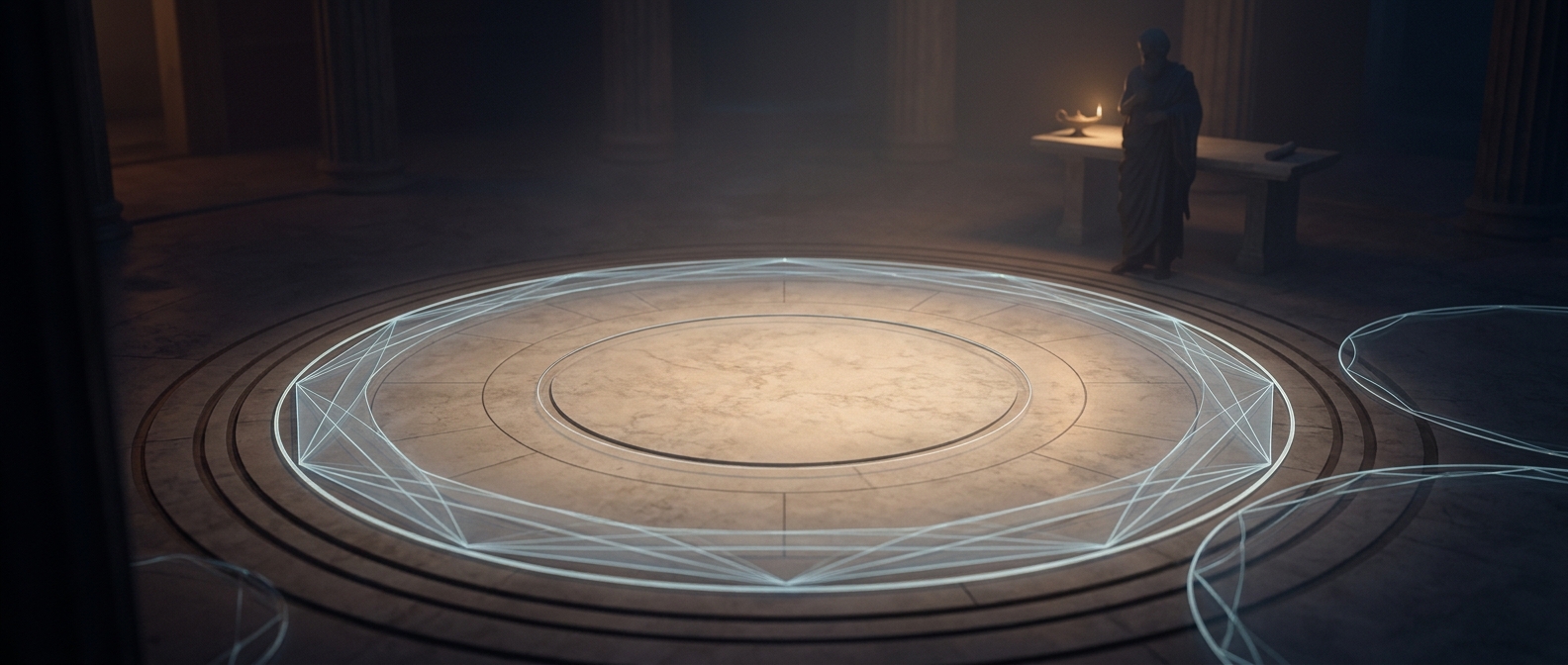
A circle’s curved edge is difficult to measure with straight tools. Archimedes sidestepped that problem by comparing the circle with shapes whose perimeters could be calculated: regular polygons drawn just inside it and just outside it. The inner polygon’s perimeter was shorter than the circle’s circumference; the outer polygon’s was longer. Together, they trapped the circumference between two known values.
To turn those bounds into an estimate of pi—the circumference divided by the diameter—he could scale the circle so its diameter was convenient to work with. The same ratio then applied to circles of any size.
Narrowing the Gap
The key was not to guess the curve’s length but to tighten the bounds. Archimedes doubled the number of polygon sides, making each straight segment shorter and the outline more like a circle. The inner perimeter crept upward, while the outer perimeter came down. Each round of calculation narrowed the range in which the true circumference, and therefore pi, had to lie.
This approach is called exhaustion: approximate a quantity from opposite directions until the remaining gap is small enough for the desired accuracy. It is an early form of a powerful mathematical idea—bounding an unknown rather than pretending to measure it exactly.
What the Method Made Possible
Archimedes’ result was not a decimal expansion of pi. It was a rigorous interval: a lower and an upper bound close enough to show how large pi could be, and how large it could not be. The achievement depended on geometry and careful arithmetic, not on tracing the circle’s edge.
That distinction is why the method mattered. A curved quantity that seemed hard to grasp became manageable through finite calculations, with the shrinking space between two perimeters serving as a measure of how much uncertainty remained.