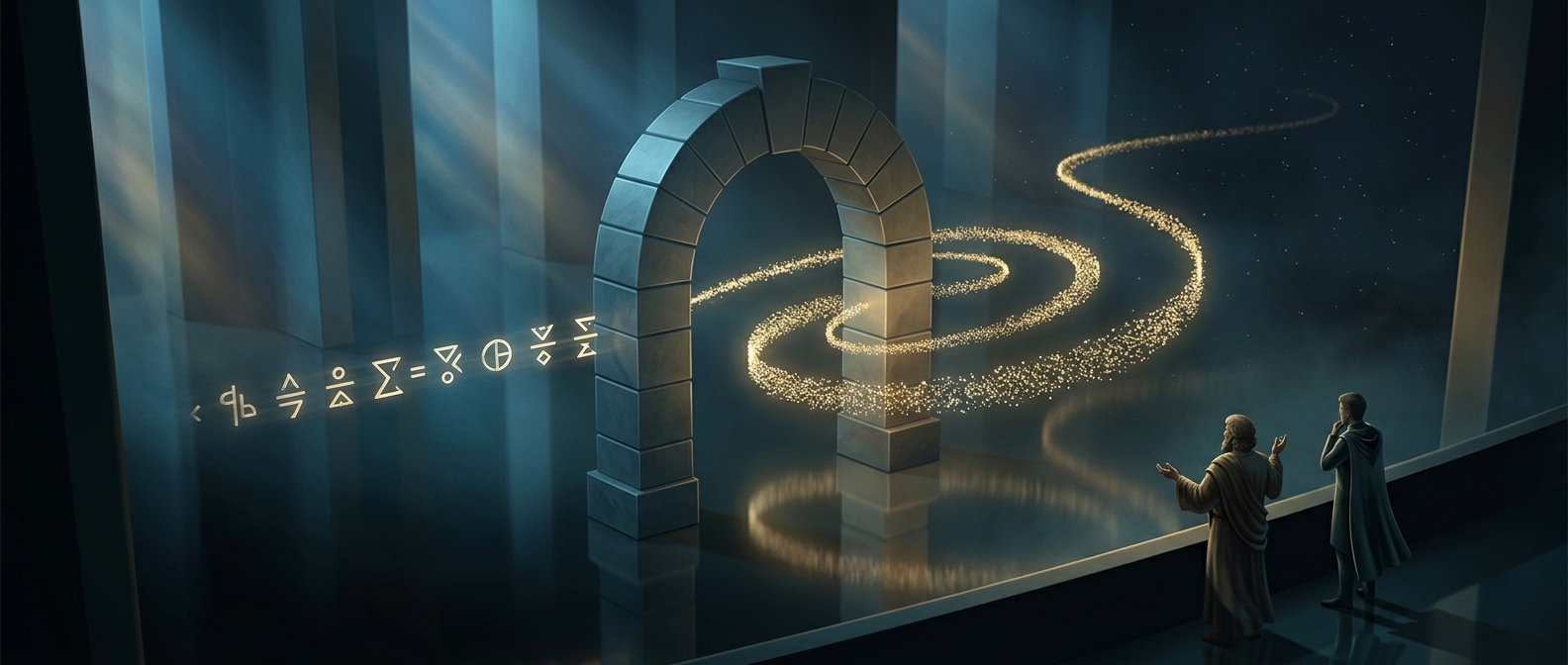
A right triangle’s sides leave a numerical trace
For any right triangle, the two shorter sides and the longest side are linked: multiply each side by itself, and the two shorter results add up to the result for the longest. In modern notation, that is a² + b² = c². The relationship is useful because it lets someone calculate an unknown length from the other two—a practical tool for measuring distances and checking whether a corner is truly square.
Knowing the rule is not the same as proving it
Babylonian mathematical records show that people worked with number triples that satisfy this relationship long before Pythagoras lived. A familiar example is 3, 4, and 5: a triangle with those side lengths has a right angle. Indian mathematical texts also describe the relationship centuries before Pythagoras.
That evidence supports an important distinction. People could recognize useful cases, calculate with them, or state the general rule without leaving behind the kind of proof later associated with Greek geometry. The surviving records do not establish exactly who first discovered the relationship, or whether it was first formulated in one place and then spread elsewhere.
How the name became the story
Pythagoras is traditionally associated with the theorem, but the name does not settle the question of priority. Mathematical ideas can circulate through practical work and teaching, while written records preserve only some of that history. Later traditions attached the result to a celebrated figure, giving a compact label to a relationship whose earlier use is documented in other cultures.
So the theorem’s name points to a long mathematical tradition, not a secure claim that one person invented it. The 3-4-5 triangle makes the enduring appeal plain: three whole-number measurements can turn the abstract rule into a way to lay out a right angle.