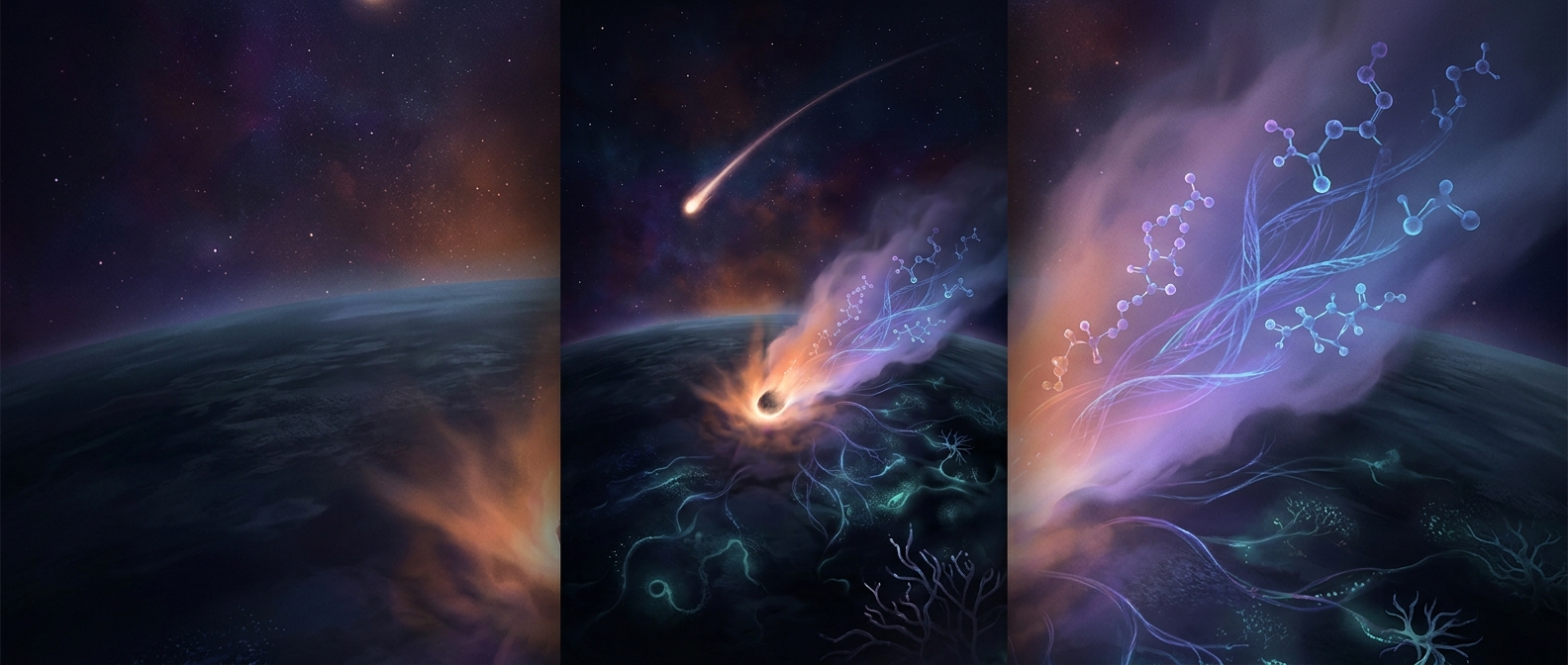
What a meteorite could bring to early Earth
Amino acids are small carbon-based molecules that cells link together to make proteins. Some meteorites contain amino acids, so impacts could have delivered these useful chemical ingredients to the young Earth. The idea matters because early Earth’s surface was being shaped by intense geological activity, while incoming space rocks offered another possible source of organic material.
But an amino acid is not a miniature piece of life. On its own, it does not reproduce, use energy, or carry out the coordinated chemistry of a cell. It is a building block—one that becomes biologically useful only when assembled into larger molecules in the right way.
Delivery is not the same as origin
For meteorite-borne amino acids to contribute to life’s beginnings, they would have needed to survive the journey through the atmosphere and the force and heat of impact, then become available in an environment where further reactions could occur. Delivery alone would not explain how simple chemicals formed more complex molecules, how those molecules began copying information, or how they became enclosed in cell-like boundaries.
Those steps are part of abiogenesis: the emergence of living systems from nonliving chemistry. The process remains a scientific question, and evidence that meteorites carried amino acids does not establish that life itself arrived from space.
A possible contribution, not a complete recipe
Meteorites could have added ingredients to the chemical inventory on early Earth, alongside compounds formed here. That makes them a plausible part of the story without making them the whole story. Even if a space rock stocked the pantry, the transformations that turned ingredients into a living system still had to happen.