Why Mercury Seems to Reverse Course
Mercury does not turn around in its orbit. It travels around the Sun in the same direction all the time, but its position against the distant stars can appear to drift backward for a few weeks. Astronomers call this apparent retrograde motion: “retrograde” describes how the motion looks from Earth, not a change in the planet’s path.
A Changing Line of Sight
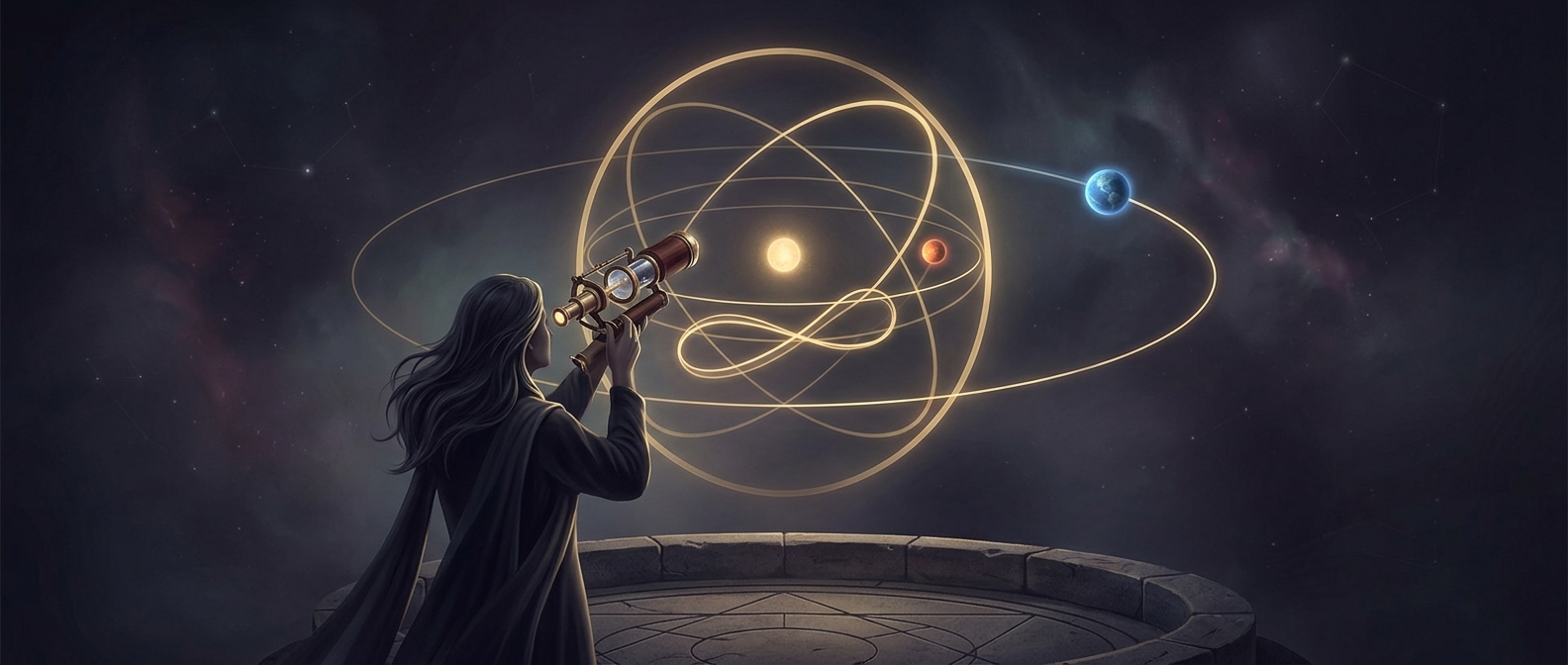
Mercury orbits closer to the Sun than Earth does, so it completes its orbit more quickly. As both planets move, the direction from Earth to Mercury shifts. Most of the time, that shifting viewpoint makes Mercury seem to travel one way across the background stars. Around the part of its orbit when Mercury passes between Earth and the Sun, the viewing angle changes in a way that makes its projected position briefly slide the other way.
The effect resembles the way a nearby object can seem to move against a distant landscape when you watch from a moving vehicle. The object has not reversed; your changing viewpoint alters where it appears to be. The comparison is only an analogy, since the planets are moving on separate paths around the Sun.
What the Apparent Reversal Means
Mercury’s backward-looking stretch is a predictable geometry of two moving planets, not a pause or reversal in Mercury’s actual journey. It is also why a planet’s motion can look different depending on when and where it is observed: the sky gives us a view from Earth, not a map of the planets’ paths from above.
That distinction matters when the phrase “Mercury retrograde” is used in astrology. The astronomical event is real as an observed change in apparent direction; claims that it causes disruptions in people’s lives are interpretations, not consequences established by the orbital mechanics.