A collision made the invisible measurable
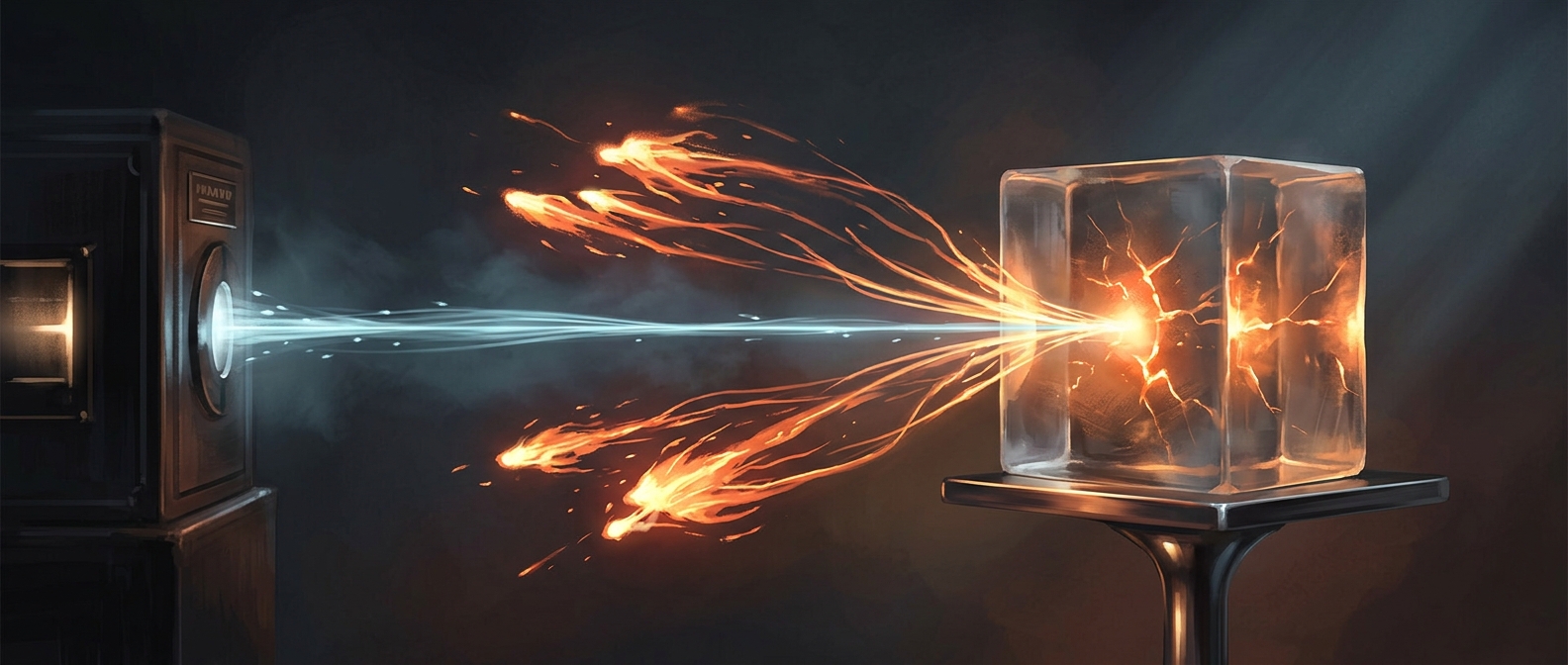
Chadwick could not observe a neutron directly. Instead, he followed the effects of radiation produced when alpha particles—helium nuclei—struck beryllium. The radiation had no electric charge, so it passed through matter without behaving like the charged particles physicists could readily detect.
Paraffin offered a way to make that radiation leave a trace. It contains many hydrogen atoms, whose nuclei are single protons. When the neutral radiation hit the paraffin, protons shot out. Their motion could be detected because fast protons ionize atoms along their paths, knocking electrons loose.
Why the recoil revealed the mass
The key was to treat each strike as a collision. A moving particle transfers energy and momentum to a target, and the amount transferred depends on the masses of both. A light particle can send a proton flying especially fast; a much heavier one can also do so, but the recoil pattern differs. By measuring the energetic protons and comparing their motion with what a collision could produce, Chadwick could estimate the mass of the unseen incoming particle.
The results pointed to a particle with roughly the mass of a proton, not to ordinary gamma radiation. That mattered because gamma rays—high-energy light—had been another proposed explanation for the neutral radiation, but they could not account for the observed proton recoils in the same way.
A new piece of the nucleus
The neutron’s lack of charge explained why it could travel through matter and into atomic nuclei without being repelled by their positively charged protons. Yet its substantial mass made it more than a faint or energetic form of light. The recoil in paraffin turned that combination—neutral but massive—into evidence for a new constituent of the atom.