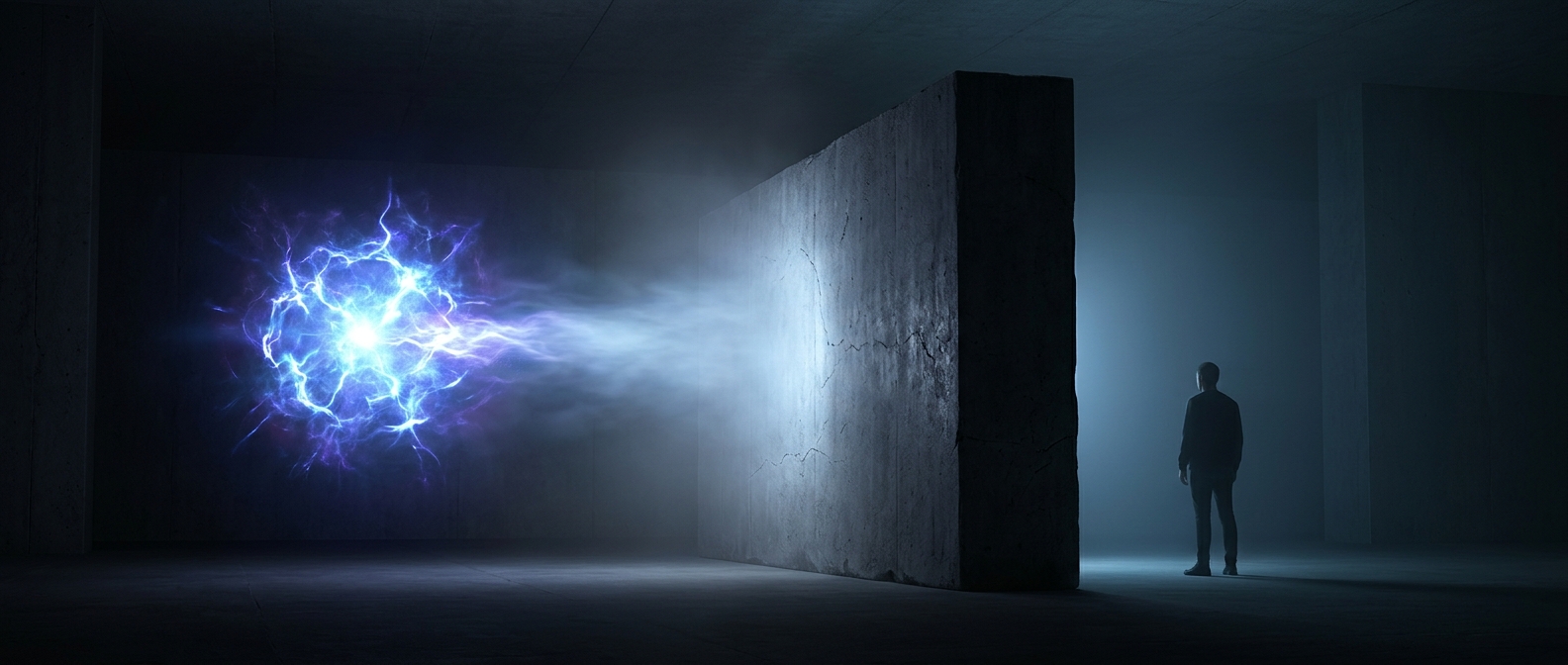
How Concrete Weakens Gamma Rays
Gamma rays are high-energy packets of light. Unlike a solid object meeting a barrier, a gamma ray has no single, predictable stopping point: as it travels through concrete, it may pass through untouched, or interact with an atom and transfer some of its energy. Some interactions knock electrons out of atoms; others redirect the ray, often with less energy.
Each interaction makes it less likely that the ray will continue along its original path with its original energy. Concrete works by placing many atoms in that path. A thicker wall gives the rays more opportunities to interact, while a denser material packs more atoms into the same distance.
Why the Required Thickness Varies
The outcome depends partly on the gamma rays’ energy. More energetic rays can penetrate farther before their chance of interacting becomes substantial, so shielding designed for them may need to be thicker. The material matters too: shielding is chosen for the radiation, the surrounding conditions, and the level of protection needed—not by applying one universal wall thickness.
That is why shielding is described in terms of reducing radiation, not stopping every gamma ray at a sharp boundary. Even after a beam passes through a substantial barrier, some radiation may remain. The practical goal is to reduce exposure enough, using an appropriately designed shield—not to assume that any concrete wall makes the space beyond it radiation-free.