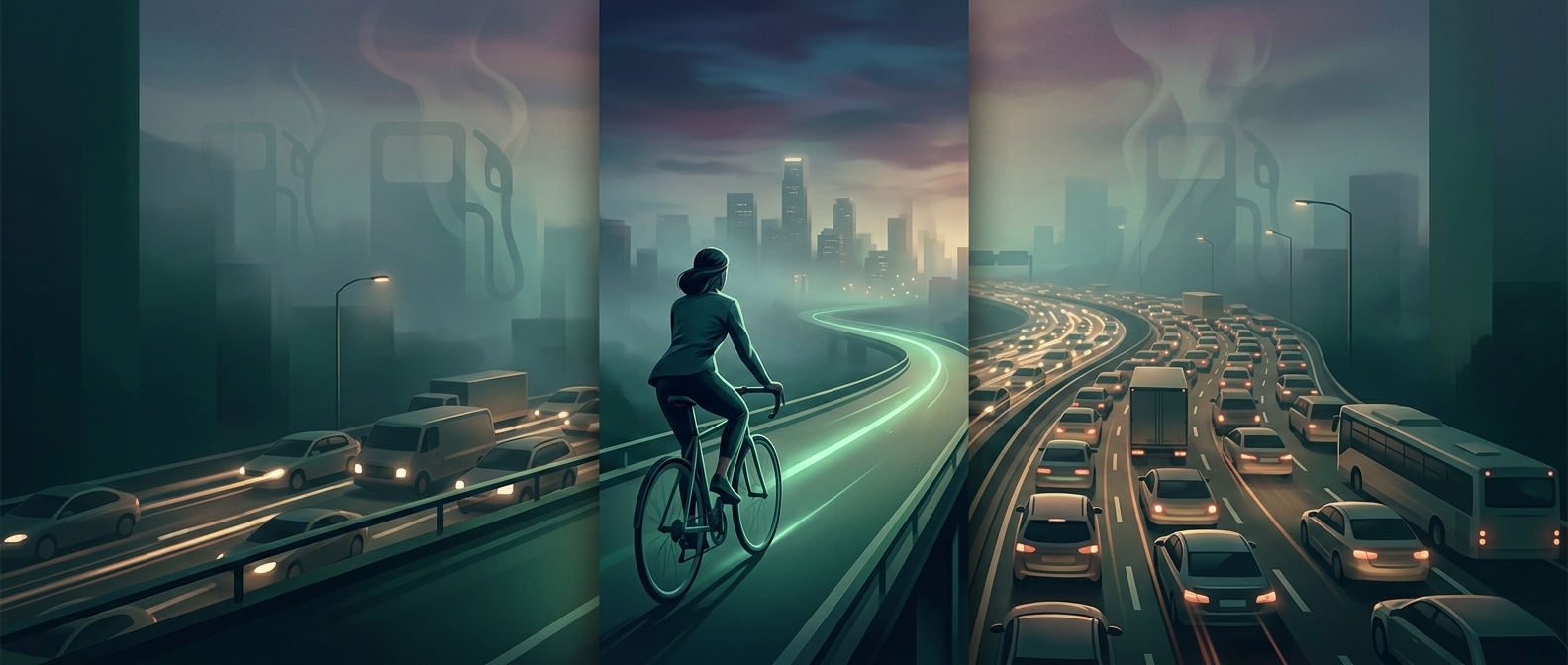
The fuel savings begin with a trip that disappears
A bicycle saves gasoline only when it replaces a journey that would otherwise have been made in a car. The key change is not that a cyclist uses less fuel per mile; it is that the car’s engine does not run for that trip at all. A short ride to a shop, school, or nearby workplace can therefore avoid a car’s fuel use from start to finish.
The arithmetic adds up across riders. For each replaced car trip, the fuel avoided depends on how far the car would have traveled and how much gasoline it would have used. Many short car journeys may seem insignificant individually, but repeated across a city, they represent a substantial amount of driving—and fuel left unburned.
Why short urban trips matter
Cars consume fuel even when covering only a small distance. They must start, accelerate, and carry the weight of the vehicle and its occupants. In stop-and-go traffic, braking repeatedly turns some of the car’s motion into heat rather than forward travel. A bicycle avoids those gasoline-powered steps, especially on trips short enough to cycle conveniently.
The comparison is not automatic: a bike ride that replaces walking or transit does not save car fuel. Nor does a household necessarily avoid buying a car simply because one person cycles occasionally. The clearest savings come from a direct substitution—using a bicycle for a trip that otherwise would have required driving.
When enough people make that substitution, the effect reaches beyond individual fuel tanks. Fewer car journeys mean less gasoline burned on local roads, with the biggest contribution coming not from one dramatic change but from ordinary trips no longer made by car.