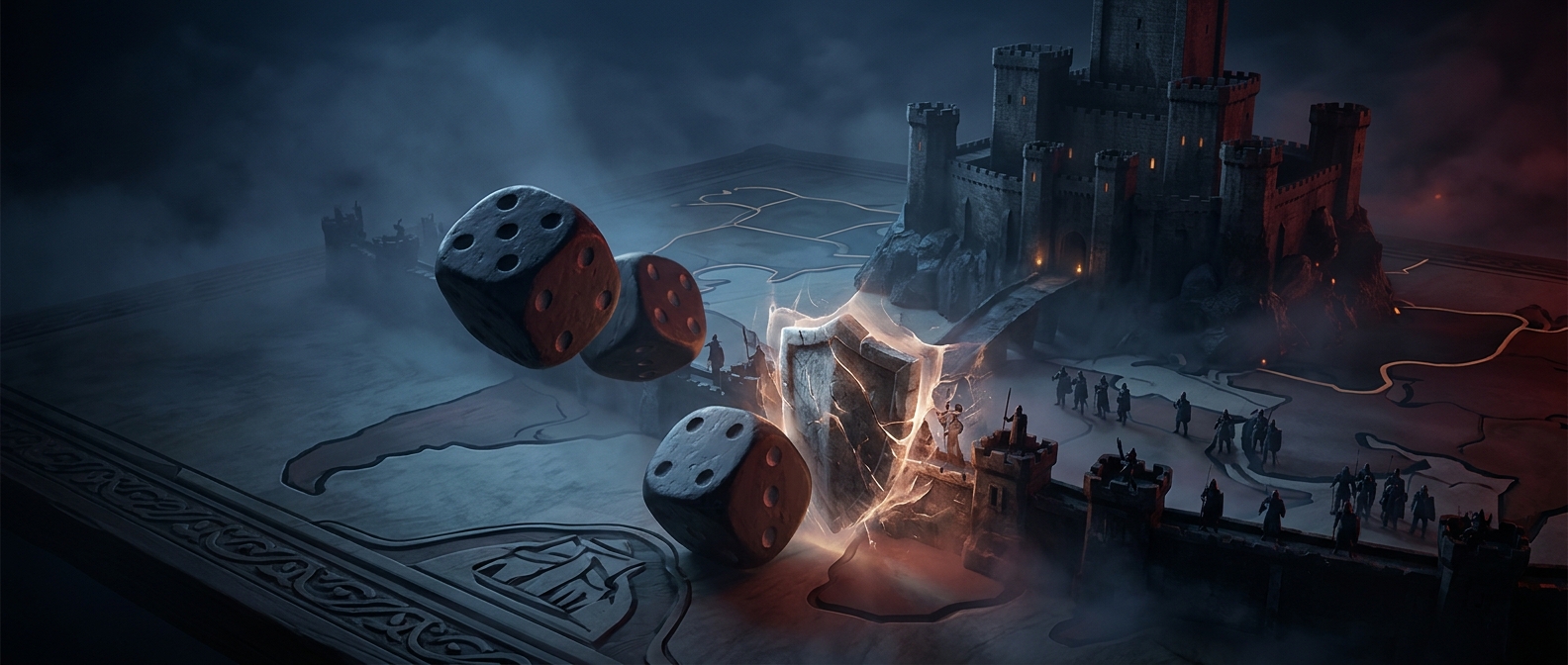
Why an even battle favors the defender
In standard Risk, each side rolls dice and the highest results are compared first; if both roll more than one die, the next-highest results are compared too. Each comparison costs one troop to the side with the lower die. Because the defender wins a tied comparison, equal rolls do not cancel out: they cost the attacker a troop.
That rule changes the arithmetic of an invasion. An attacker may roll up to three dice, while a defender can roll up to two, but extra dice do not guarantee extra wins. At close numbers, the attacker can lose troops even when the dice look evenly matched. A modest lead can disappear before the attacker has enough wins to clear the territory.
Why attackers build a margin
Risk makes an attack a sequence of exchanges, not one decisive roll. The attacker must keep enough troops to continue, and must leave at least one behind in the territory they attack from. A force that barely outnumbers the defender may therefore have little room for a bad exchange. More troops provide a buffer against losses and make it likelier that the attacker can keep rolling until the defenders are gone.
The choice is not simply “attack or don’t.” Players can stop after a round, preserve their army, or commit more troops for a better chance of finishing the conquest. The defender’s tie advantage makes that decision especially consequential: an attacker needs a surplus not just to overwhelm the defenders, but to pay the cost of getting past them.