How Mathematicians Tell Knots Apart
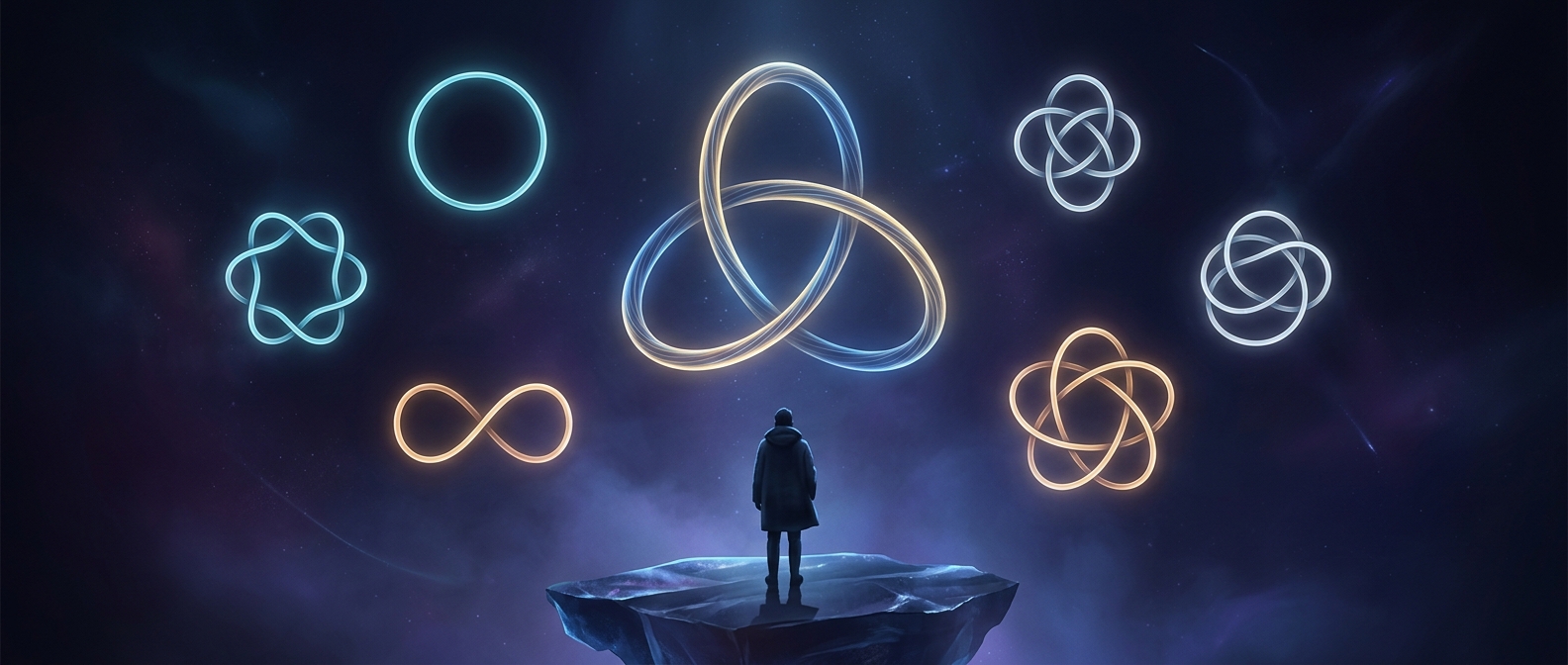
A drawing can make a loop look complicated even when its crossings are only an artifact of how it was arranged. To classify the loop, mathematicians ask a stricter question: can the drawn knot be reshaped into a plain circle without cutting it or allowing one part to pass through another? If so, the tangle is mathematically trivial, however intricate the sketch appears.
Crossings Can Move Without Changing the Knot
In a flat diagram, a crossing records which strand passes over the other. Sliding or twisting strands can change the number and position of crossings, so simply counting them does not reliably identify a knot. Mathematicians instead look for properties that stay unchanged through allowed deformations. Such a property is called an invariant: if two diagrams have different values for it, they cannot represent the same knot.
Some invariants are easy to compute but distinguish only certain knots; others are more powerful but harder to work out. No single visual inspection settles every case. The challenge is to find a dependable test that survives all the permitted reshaping.
Why the Rules Matter
The ban on cutting and self-crossing is what gives knot theory its subject. If strands could pass through one another, any tangle could be smoothed into a circle and there would be nothing to classify. Under the real rules, a loop’s appearance can change dramatically while its underlying knot remains the same—and a crossing that cannot be eliminated by any allowed motion marks a genuine difference.
That distinction is useful beyond drawings: knot theory provides a mathematical language for studying tangled curves and the ways their structure can persist as they move.