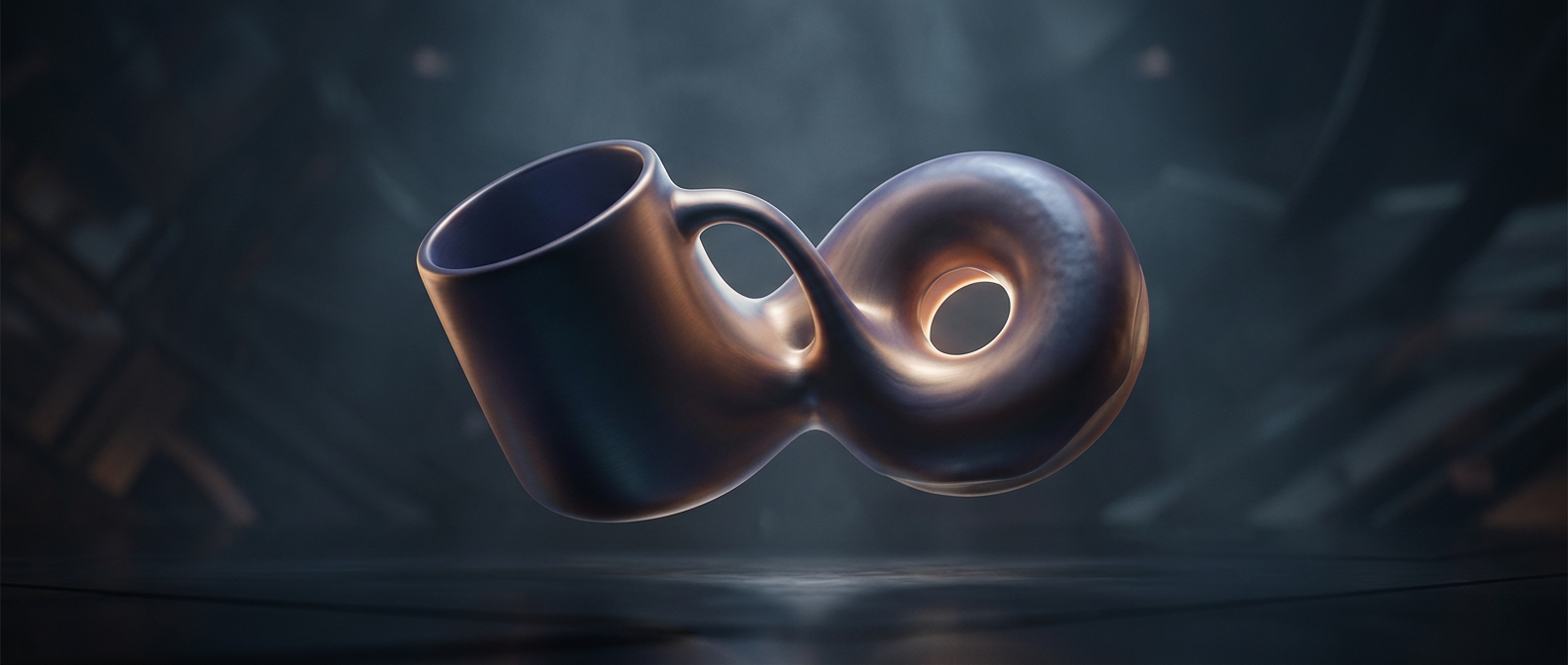
Topology counts tunnels, not shapes
Topology studies which properties of a shape survive smooth stretching and bending. It sets aside measurements such as length, curvature, and thickness, and focuses instead on features that cannot disappear without tearing the material or joining separate parts.
For a mug, the crucial feature is the tunnel through its handle. The hollow space inside the cup is an opening, but it is not a tunnel through the material in the same sense: the mug’s rim connects the inner and outer surfaces. The handle creates a passage all the way through the object. A doughnut has the same kind of passage through its middle.
Why the handle can become a ring
Imagine the mug made of pliable clay. You could lengthen and widen the handle, then gradually reshape the cup’s walls and base around it. The mug might become a simple ring, with its original handle opening forming the ring’s central hole. The clay can change proportions dramatically; it cannot be cut or fused, because either action could change the number of tunnels.
That unchanging count is a topological invariant—a feature preserved by the allowed deformations. In more formal language, a mug’s surface and a doughnut’s surface each have genus one: one handle-like tunnel. Add another handle and the count changes, so the new shape belongs to a different topological class.
The comparison is useful precisely because it ignores what makes the objects function differently. A mug can hold coffee; a doughnut cannot. Topology asks a narrower question: if shape and size do not matter, what structural feature remains? Here, the answer is the single tunnel.