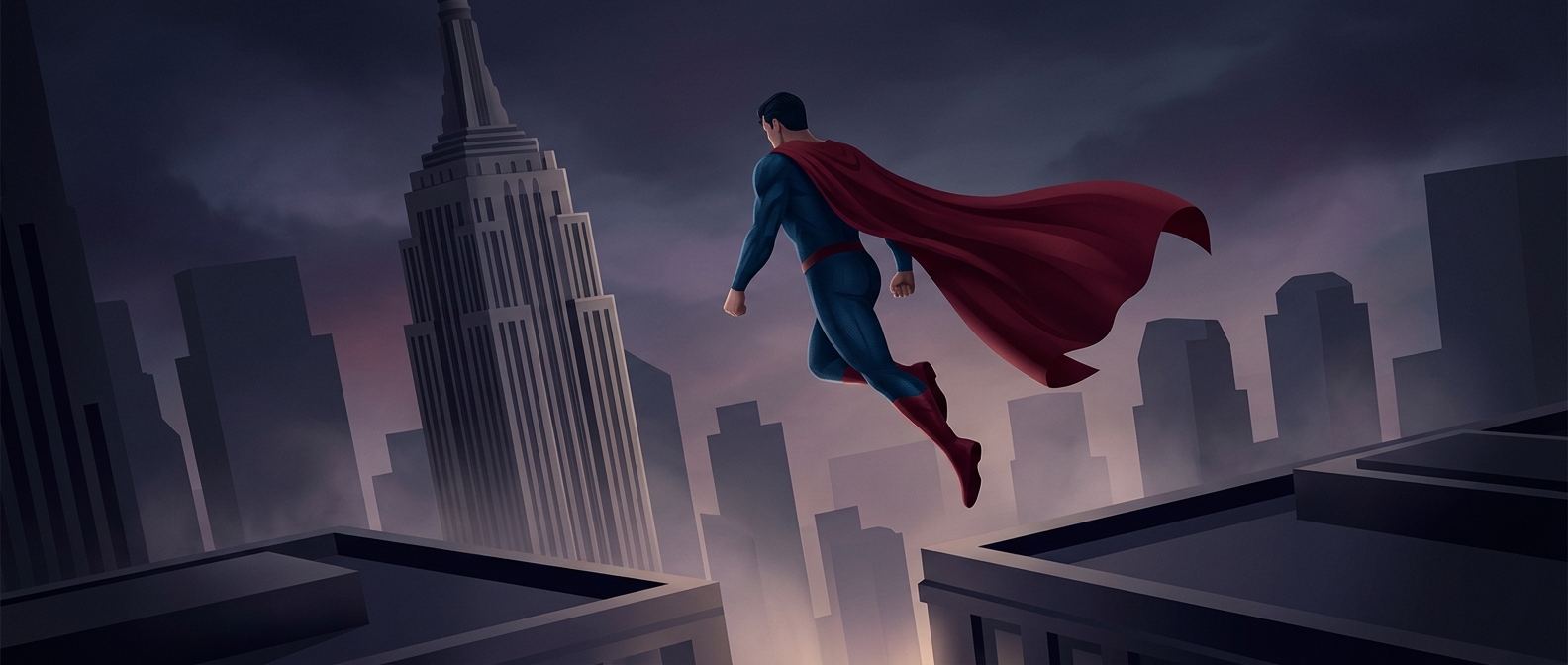
A leap was the original visual rule
In Superman’s early comic-book appearances, he did not soar through the sky. He could cover enormous distances in a single bound, but each trip still had the logic of a jump: push off, travel through an arc, and come down somewhere else. The distinction mattered because it shaped how artists staged his movement. A leap carried him across a scene; flight would let him hover, turn, or change direction in midair.
Why animation changed the motion
Animating a sequence of repeated leaps meant drawing Superman’s body through each takeoff and landing, then showing the ground and background shift beneath him. That takes many drawings to make the movement feel continuous. Flight offered a simpler visual solution: hold him in a flying pose and move him across the frame. The audience could read the motion immediately, without watching a full jump cycle each time.
That economy also made action easier to stage. A flying Superman could approach a problem from above, stop beside someone, or redirect himself without needing a visible surface to push off from. A practical shortcut for animators therefore made his movement more flexible on screen.
A production convenience became part of the character
Once audiences saw Superman flying in animation, the image became hard to separate from the character. The change was not just a new way to draw an old power: it widened what scenes Superman could take part in and made the sky a space he could move through freely. Flight became one of the clearest visual signals that he was unlike an ordinary person.
The memorable irony is that one of Superman’s defining abilities began as a way to avoid drawing so many landings.