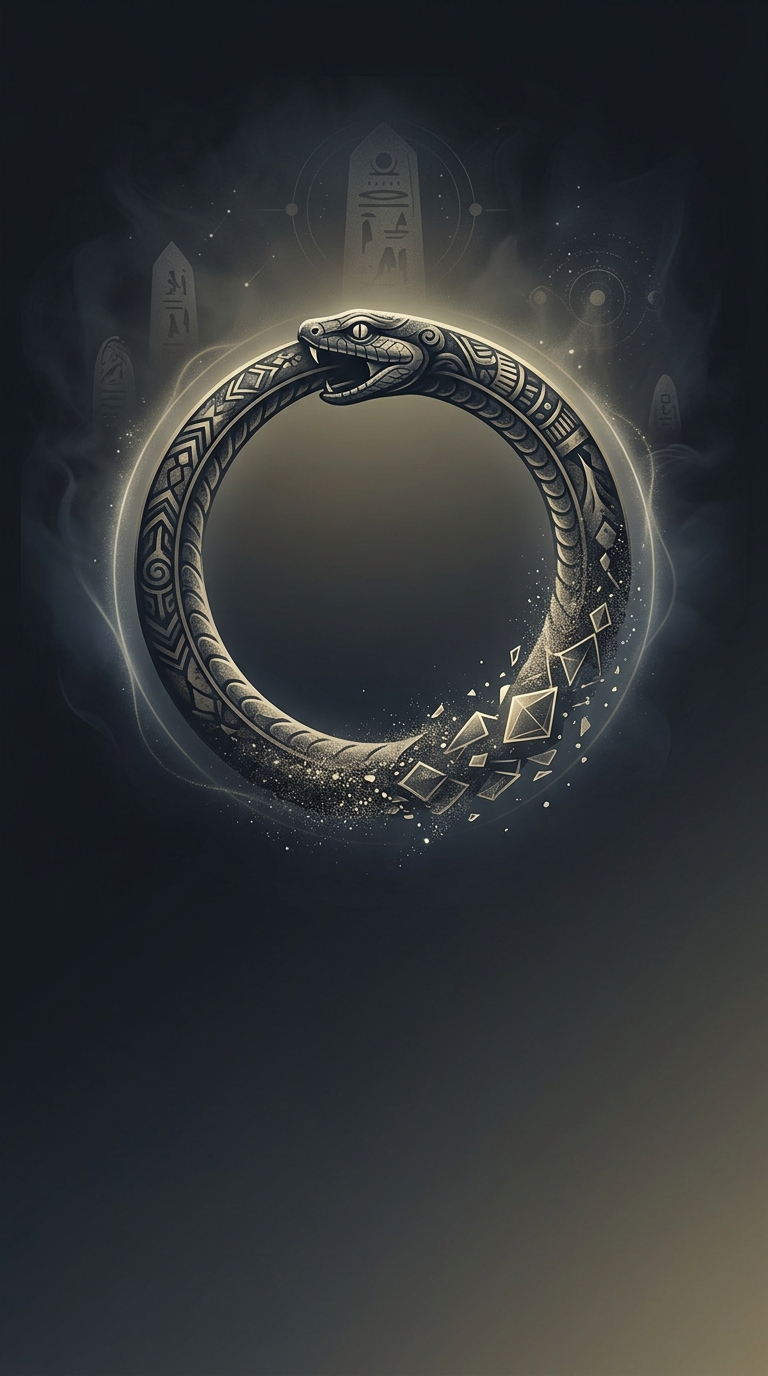
A circle drawn around renewal
The ouroboros—a serpent shown with its mouth at its own tail—appears in ancient Egyptian funerary imagery as more than a picture of endless motion. In a burial text, a circle made by the serpent could frame a scene of cosmic renewal: the sun’s nightly passage through the underworld and its return at dawn. The image connected death not only with an ending, but with a passage into another phase of existence.
Its shape makes that idea immediate. The serpent consumes its own tail, so its end becomes its beginning; there is no visible point where the cycle breaks. In a funerary setting, that closed loop could suggest persistence and rebirth without needing to show a journey’s full sequence.
From cosmic cycle to alchemical change
Centuries later, European alchemists adopted the symbol and gave it a related but distinct emphasis. Alchemy involved attempts to transform substances through processes such as heating and separation; its practitioners also used material change to think about spiritual transformation. The ouroboros suited both meanings: a substance could be broken down and recombined, while the circle suggested a process that continually returned to itself.
The symbol’s meaning therefore shifted with its setting. In Egyptian funerary tradition, it could mark cosmic renewal and the hope of continued existence; in alchemical writing, it could stand for eternity and transformation through destruction. Its most memorable feature carries both ideas: what appears to be consumed is also what keeps the cycle going.