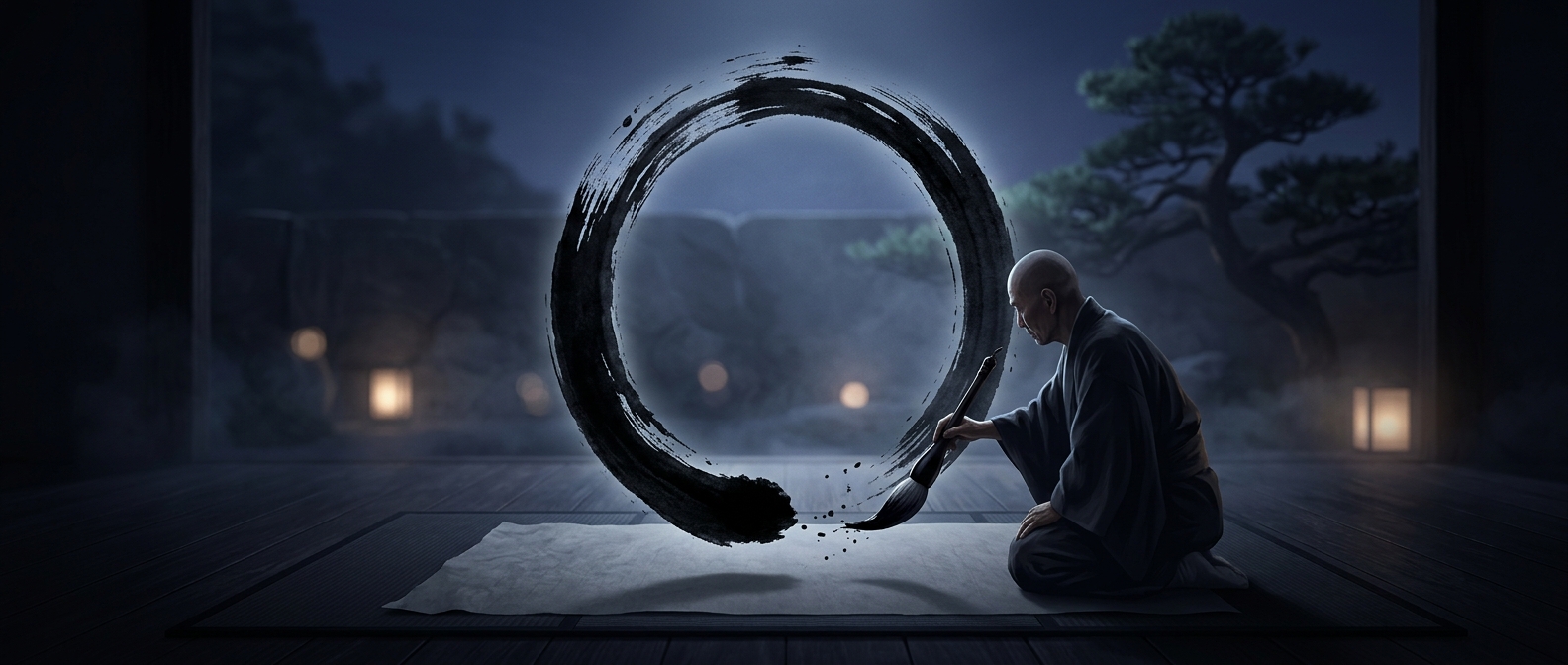
A circle made in one breath of motion
An ensō is a circle painted with a brush, usually in one continuous stroke. The painter cannot pause midway to tidy the curve or erase a wobble: the brush’s pressure, speed, and changing supply of ink remain visible in the mark. A stroke may be broad and dark where the brush presses firmly, then thin or dry as it lifts and runs out of ink.
That constraint makes the circle less like a geometrical diagram and more like a record of a particular action. The artist prepares, then commits to the movement; the finished mark preserves its unevenness rather than correcting it.
Why the opening matters
Many ensō are not fully closed. The gap can be read in different ways, including as a sign of openness or incompleteness, but there is no single fixed interpretation for every circle. A closed form may suggest wholeness; an open one can leave room for what has not been resolved. In Zen Buddhist settings, the image is associated with ideas such as emptiness and enlightenment, though painting one is not a mechanical route to either.
The practice joins intention with acceptance of what happens. A painter can train control of the brush, but cannot make every stroke perfectly predictable. The circle’s rough edge and open space are therefore not necessarily flaws to repair; they are part of what the act has produced.
The stroke as the subject
Because the brushstroke cannot be revised without changing the work, an ensō draws attention to the moment of making as much as to the shape itself. Its simplest lesson is visible on the page: the circle does not conceal the hand that made it.