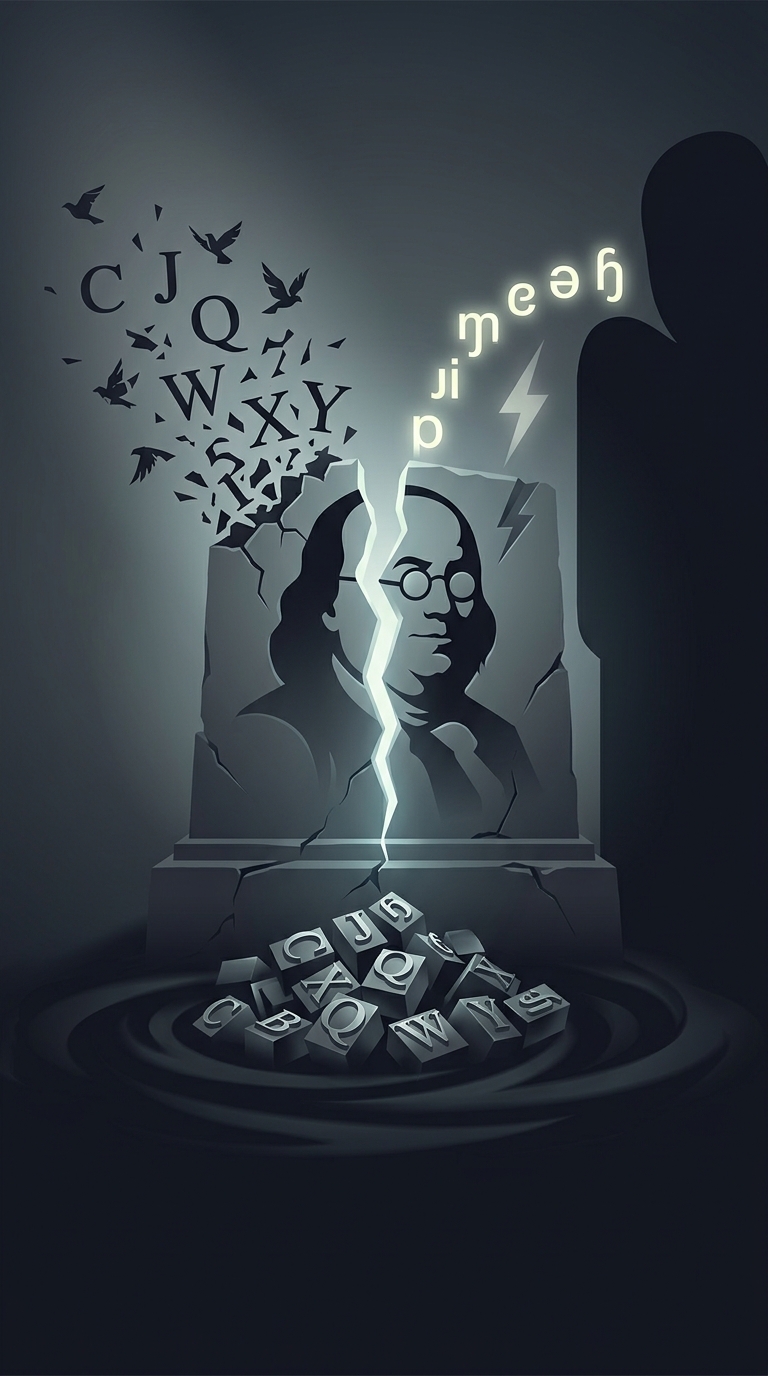
Franklin’s alphabet was a redesign, not a spelling patch
Franklin’s proposal treated written English as a tool that should represent speech more directly. In ordinary spelling, the same letter can stand for different sounds, while the same sound can be written in different ways. His system aimed to give each speech sound a consistent written sign. To do that, he removed six familiar letters and introduced new characters for sounds that English spelling represented awkwardly.
That distinction matters: Franklin was not simply asking people to spell existing words differently. He was asking them to learn a replacement alphabet, with unfamiliar symbols as well as unfamiliar spellings.
The reform had to solve a social problem, too
A phonetic alphabet could make the relationship between speech and writing more predictable. But changing the rules on paper would not change what readers already knew. Children, adults, printers, and teachers would all have to learn the new signs, while books and documents set in the old alphabet remained in circulation.
Printing made the obstacle tangible. Printers needed type for the proposed characters, and readers needed practice recognizing them. Franklin designed special type to demonstrate that the system could be printed, but a working typeface was only one step toward adoption. The larger task was persuading a whole reading public to switch together.
Familiar letters carry more than sounds
English spelling is inconsistent, but it also connects readers to a shared stock of books, habits, and conventions. Replacing letters could make pronunciation easier to represent while making existing writing harder to read. Franklin’s experiment therefore exposed the central tradeoff in alphabet reform: a system can be more logical on its own terms and still be costly to adopt.
His alphabet did not displace the one people already used. Its fate shows why a better-designed writing system is not enough by itself: it must also be easier, in practice, for a community to learn and use than the system it inherits.