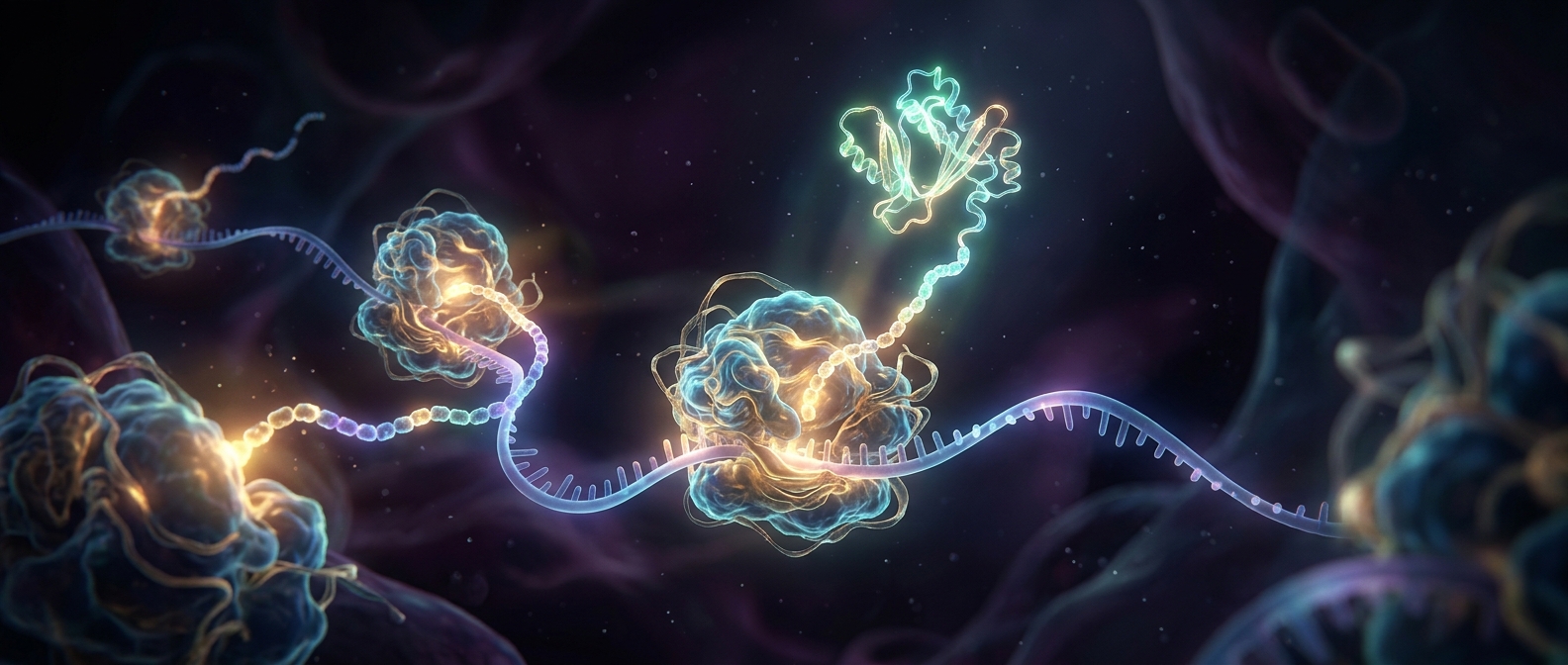
How a genetic message becomes a protein
A ribosome does not read DNA directly. In animal cells, a working copy of a gene is made as messenger RNA, or mRNA, which carries the instructions from the cell’s nucleus to a ribosome. The ribosome grips this strand and advances along it, reading three RNA letters at a time. Each three-letter unit, called a codon, specifies an amino acid or tells the ribosome to stop.
Matching the code to its building blocks
The ribosome relies on transfer RNA, or tRNA, to bring the right amino acid for each codon. One end of a tRNA matches the codon; the other carries its amino acid. The ribosome checks the match, links the new amino acid to the growing chain, and moves on to the next codon. Repeating this cycle turns the sequence in the mRNA into a precise sequence of amino acids.
That order matters: it helps determine how the chain folds into a shape that can do a particular job. Some proteins become structural parts of cells; others act as enzymes, speeding up chemical reactions. Cells can also modify proteins or send them to specific locations after they are made.
Where a ribosome works
Ribosomes float freely in the cell or attach to the surface of the endoplasmic reticulum, a folded membrane network. Free ribosomes commonly make proteins used inside the cell. Ribosomes on the membrane often make proteins destined for membranes or for release outside the cell. The ribosome’s basic task is the same in both places, but its location helps route the finished product.
This makes protein production more than a matter of assembling parts: the message, the amino-acid sequence, and the cell’s routing system together shape what a protein can do and where it can work.