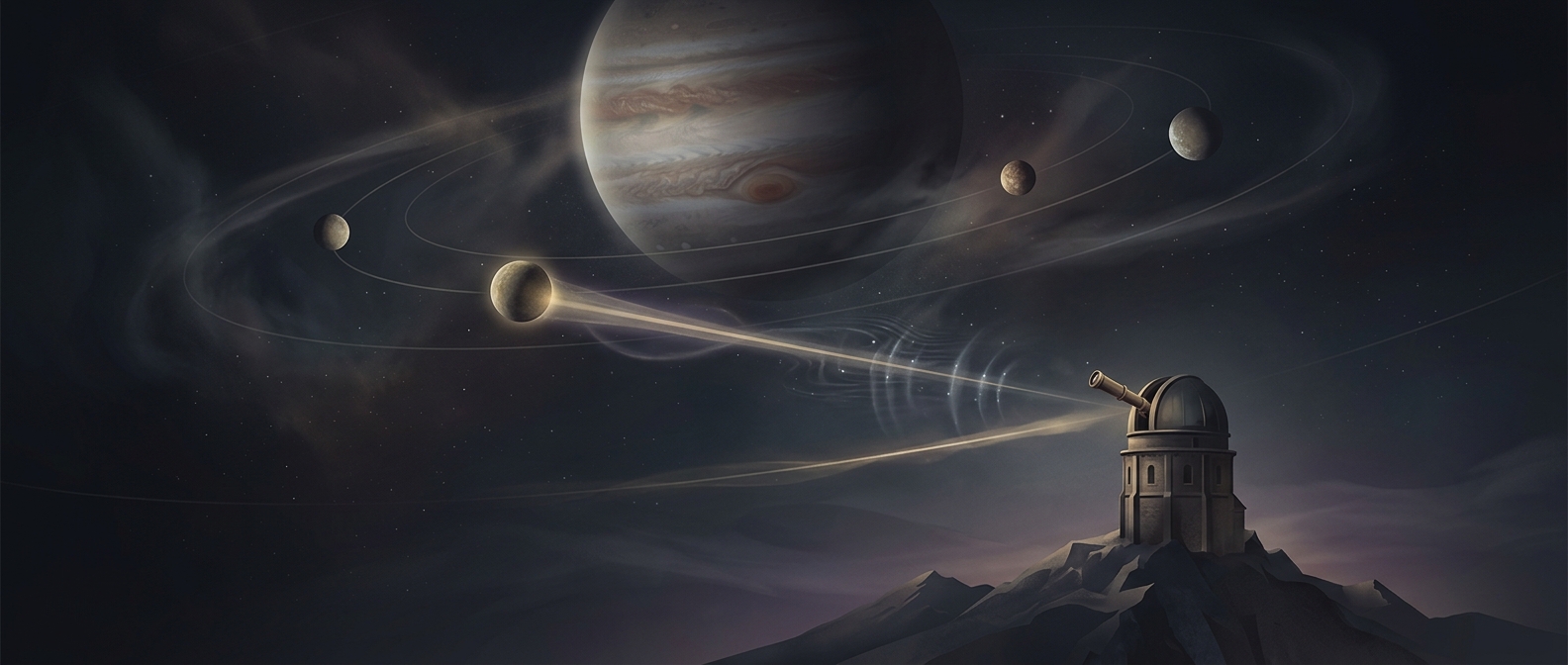
A moon became a clock in Jupiter’s shadow
Io, Jupiter’s innermost large moon, circles the planet so quickly that it regularly slips behind Jupiter and disappears from view. Astronomers could predict when each eclipse should occur, making the events a dependable celestial time signal. But the observed times did not always match the predictions.
The missing time depended on Earth’s position
The key was that an eclipse’s light does not reach Earth instantly. When Earth was on the far side of its orbit from Jupiter, the signal had farther to travel than when Earth was nearer. The eclipse therefore appeared later from Earth at the more distant position.
That changing delay could not be explained by Io suddenly changing its orbit each time Earth moved. It fit a simpler account: light takes time to cross space, and the extra distance adds extra travel time. Comparing the eclipse schedule at different points in Earth’s orbit made the effect measurable.
From timing mismatch to a physical speed
The astronomers could estimate how long light took to cover the change in distance between Earth’s positions. Dividing distance by travel time gives speed. This was an early demonstration that light’s speed is finite, rather than instantaneous, and it turned a timing discrepancy into evidence about a basic property of nature.
The practical insight is still familiar: a signal from far away shows the past, not the present. Io’s eclipses made that delay visible in the schedule of a moon disappearing behind a planet.