A message built from things that can be measured
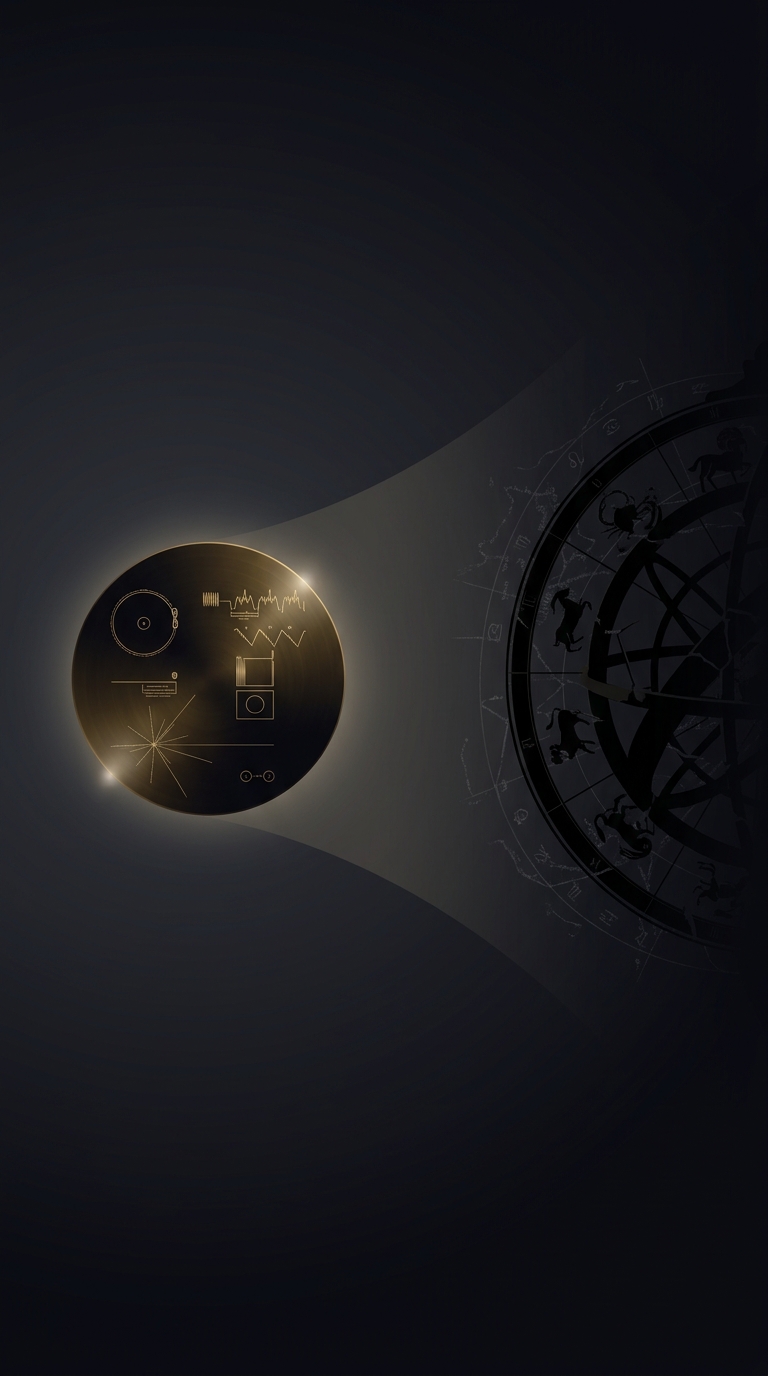
The Voyager Golden Records were designed to carry information beyond Earth, but they were not an encyclopedia of human beliefs. Their contents favor things that could be represented through physical patterns: diagrams, recorded sounds, images, and music. Astrology and the zodiac wheel do not appear on the records.
That contrast is revealing. A zodiac wheel depends on human conventions about how constellations relate to personality and fate. A diagram of a biological process, by comparison, can show shapes and relationships that a viewer might inspect even without sharing those beliefs. The record’s cover also uses a map based on pulsars—rapidly rotating stellar remnants—to indicate the Sun’s location. That is astronomy: a physical reference point, not an astrological chart.
How the records try to explain themselves
The records are phonograph discs, and their cover carries diagrams intended to explain how to play them and interpret their contents. Some of the instructions use basic mathematical relationships and the properties of the hydrogen atom as reference points. The idea was to give a recipient clues for decoding the disc without assuming they used Earth’s units or had seen a record player before.
The contents then broaden from scientific and biological images to greetings, sounds, and music. Chuck Berry’s “Johnny B. Goode” is among the selections. Music is not a mathematical diagram, and an unfamiliar listener might not hear it as humans do; it is an expression of culture rather than a universal key.
A portrait, not a complete account
Leaving astrology out did not make the records a neutral or complete picture of humanity. Any selection reflects choices about what to send and what could fit in a message meant to cross an enormous gulf of language and experience. The records instead combine attempts at physical explanation with a small sample of human life—and leave many parts of human culture unrepresented.