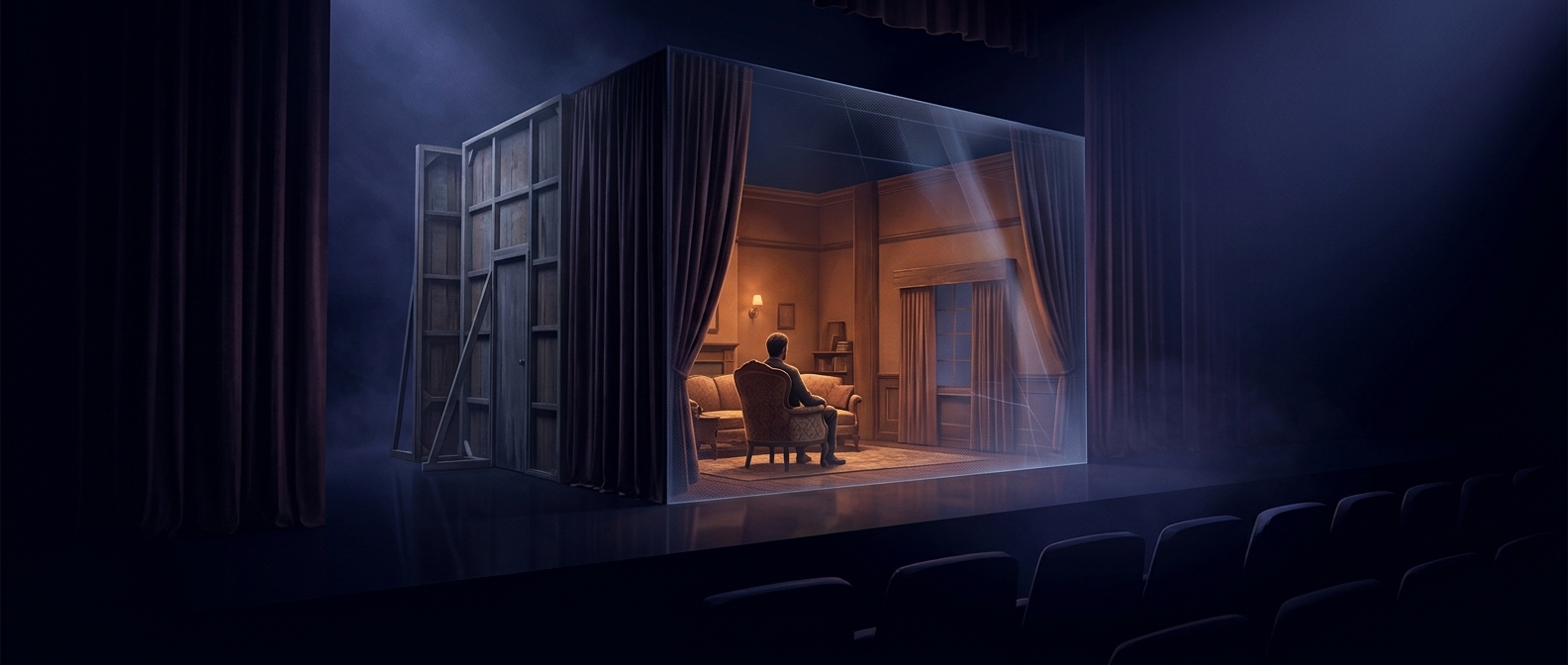
How an Open Side Became a Wall
A room onstage may have only three built walls, but audiences are invited to imagine a fourth across the open side. That imagined boundary is part of the theater’s convention of observation: spectators can see the action, while characters behave as though no one is watching. The set supplies the room; performance supplies the missing wall.
This convention lets a play show private life in public. An actor can speak in a kitchen or bedroom without acknowledging the people seated beyond the stage. The audience, meanwhile, is treated like an unseen observer rather than a participant in the scene.
What It Means to Break the Wall
When a performer looks directly at the audience, addresses it, or otherwise acknowledges that spectators are present, the performance breaks the fourth wall. The moment can create a joke, reveal a character’s private thoughts, or interrupt the illusion of ordinary life. It works because the audience has first accepted the opposite rule: that the scene proceeds as if the room were closed.
The idea also travels beyond the physical stage. In film and television, a character who turns to speak to viewers can break the fourth wall even though no box set is involved. In either medium, the “wall” is not a structure to remove; it is an agreement between performers and audience about who knows they are being watched.