How paper fairies became photographic evidence
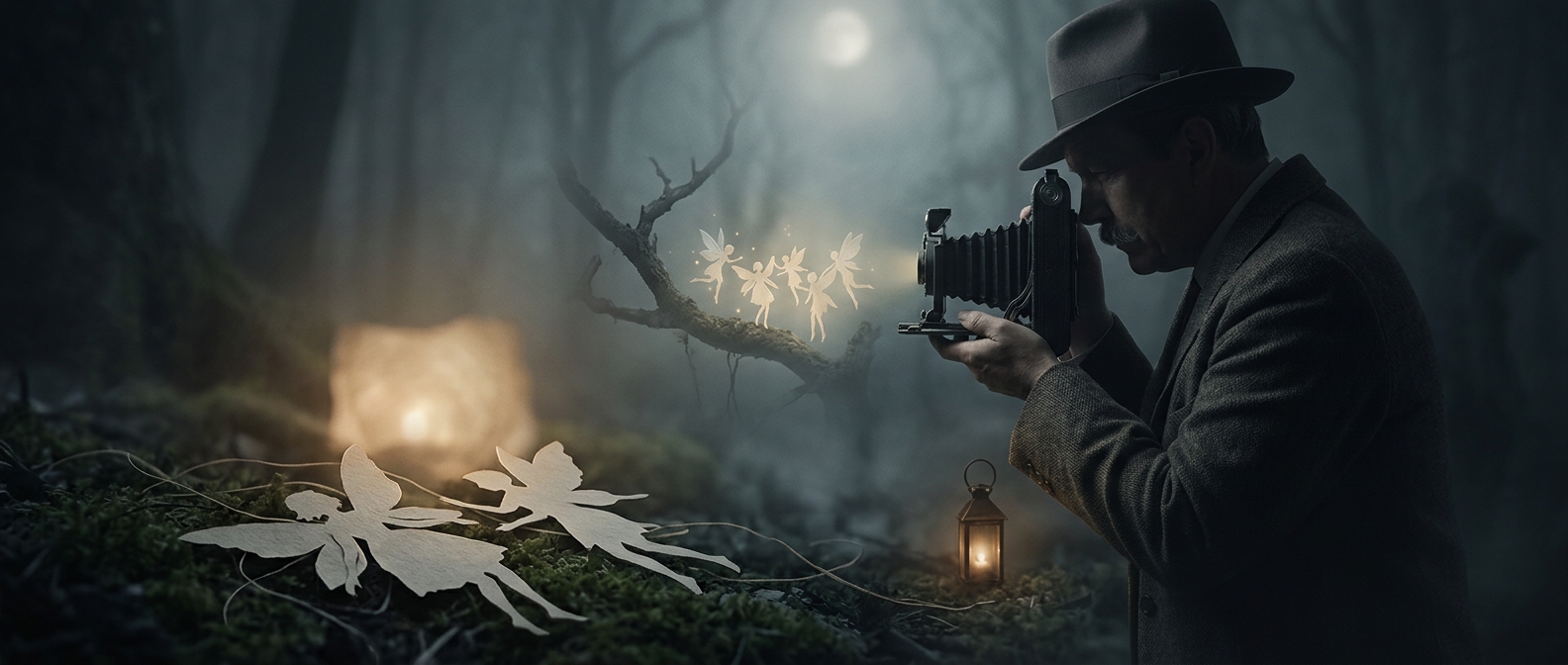
The Cottingley fairy photographs began with two young cousins in England: Elsie Wright and Frances Griffiths. In 1917, they posed for pictures near a stream, with small fairy figures arranged among the plants. The figures were cut from paper and held upright with hatpins. Because the pins were difficult to see in the finished images, the fairies seemed to occupy the same space as the girls and foliage.
That simple setup exploited a weakness in early photography: a photograph could look like direct proof while hiding the staging that produced it. The pictures were grainy and lacked the sharp detail that might have exposed the cutouts. Viewers also had no easy way to inspect the scene or repeat the exposure. The image offered a compelling impression, but not a reliable way to tell whether its subjects were real.
Why Arthur Conan Doyle believed
The photographs reached Arthur Conan Doyle, the creator of Sherlock Holmes, who was also deeply interested in spiritualism—the belief that the living could make contact with the dead and other unseen beings. He treated the images as evidence for a world that he already thought might exist. Their apparent photographic clarity mattered, but so did the story he was prepared to see in them.
The pictures became famous partly because the mismatch was so striking: delicate paper figures persuaded a celebrated writer associated with careful reasoning. Years later, the cousins acknowledged that the fairy figures had been staged. The episode remains a reminder that a convincing image can confirm a belief when viewers mistake the camera’s record of a scene for proof of what the scene contains.