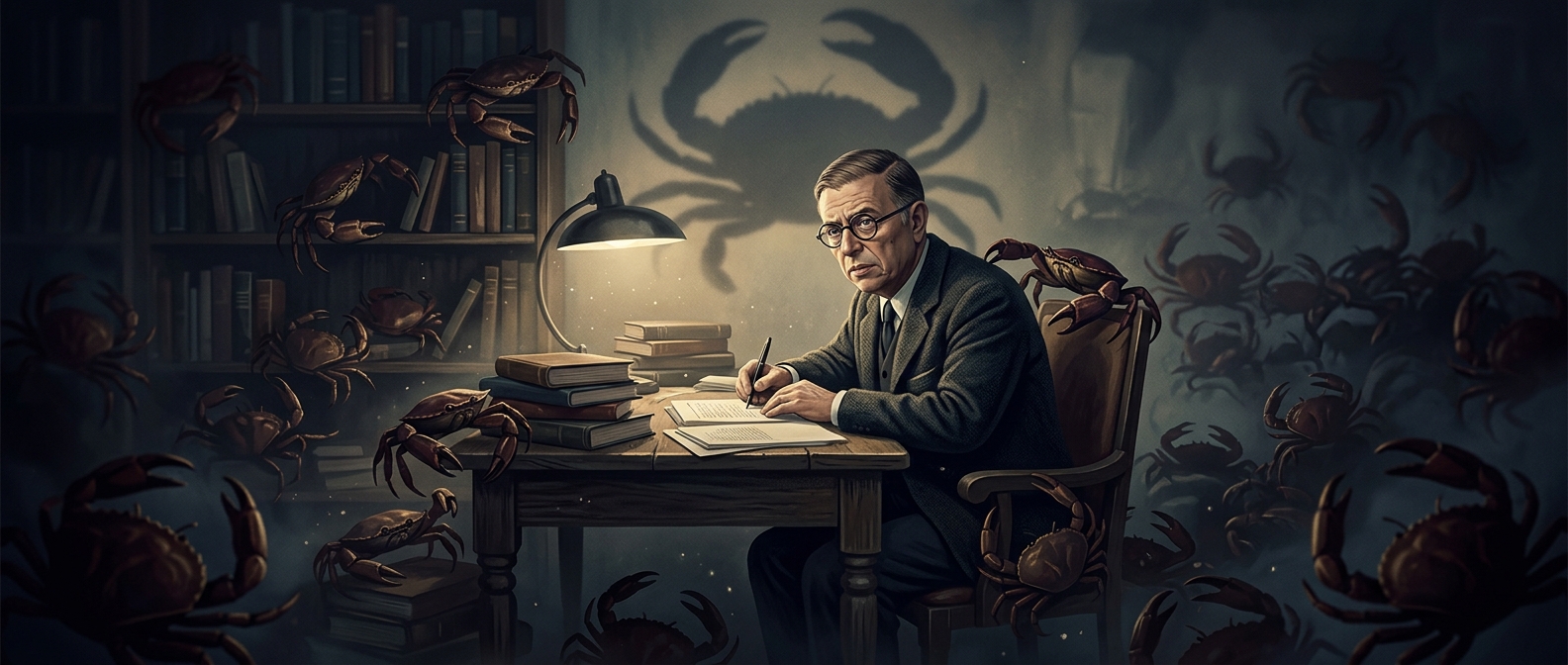
When an Altered Perception Followed Sartre Home
Jean-Paul Sartre’s crab episode is often remembered as an unusually vivid aftereffect of a mescaline experience. Mescaline is a psychedelic drug that can disrupt ordinary perception, making imagined or distorted sights feel strikingly real. In Sartre’s reported case, the experience did not remain confined to the moment of intoxication: he believed unseen crabs were present around him in Paris.
The unsettling part was not simply picturing a crab. It was the sense of being accompanied by something he could not see and could not readily dismiss. That gap between what the senses register and what the mind treats as real helps explain why the story has endured.
From Threat to Odd Companionship
The episode’s reported change in tone matters. Sartre eventually regarded the crabs as strange but harmless, rather than as pursuers he needed to escape. That does not make the experience ordinary or prove that the crabs existed; it shows how a frightening perception can become less threatening when a person’s interpretation of it changes.
The story is a small, memorable glimpse of a broader feature of hallucination: vividness alone does not determine whether an experience feels dangerous. In Sartre’s telling, the invisible visitors became less like attackers and more like peculiar company—an unsettling episode recast as an absurd presence in everyday Paris.