How Hades trailers make motion feel unpredictable
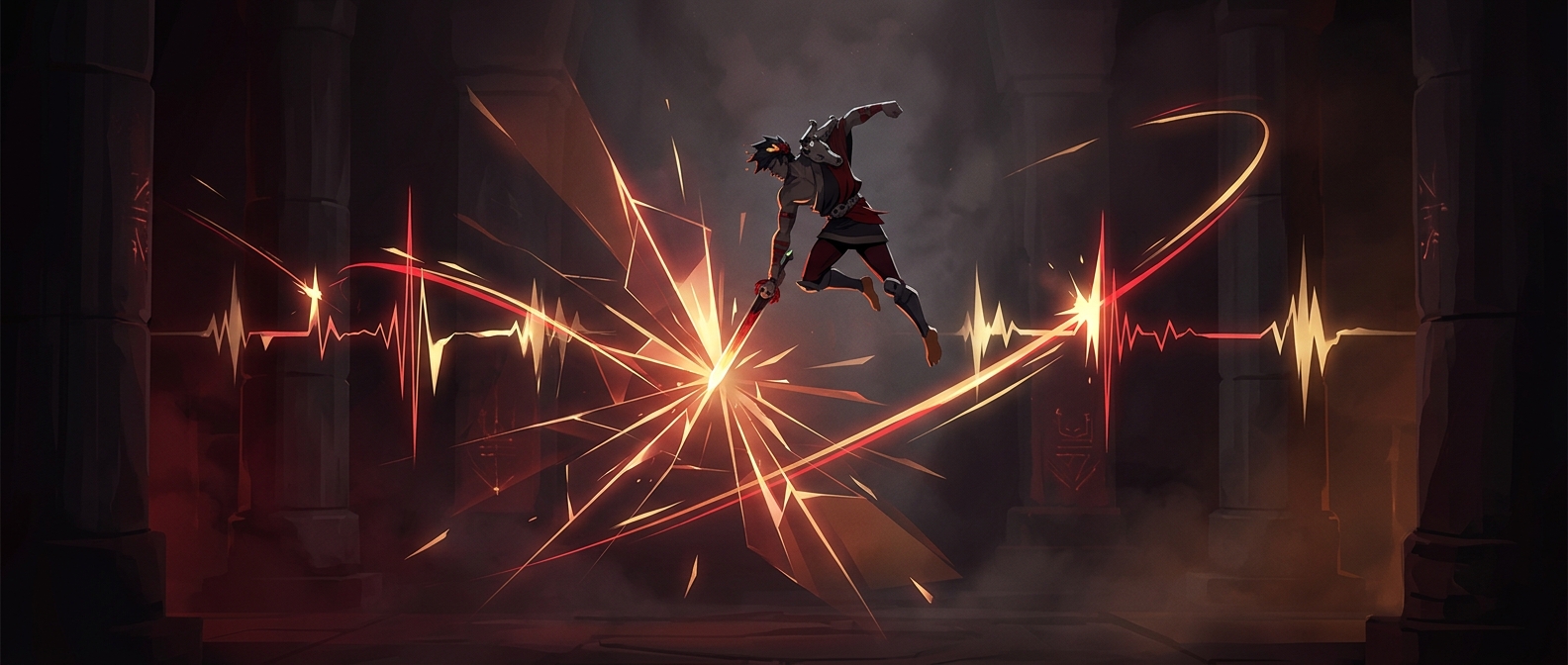
A sword slash landing on a soundtrack’s strongest beat is easy to anticipate: the music announces the impact, and the edit confirms it. Hades trailers often do the opposite. They place dashes and attacks in the spaces between the heavy beats, where the music’s rhythm is still moving but offers less obvious punctuation.
That technique is called syncopation: emphasizing weaker beats or the gaps between them instead of repeatedly stressing the beat listeners expect. The action remains tied to the music, but the timing feels slightly off balance—in a deliberate, controlled way.
Why the off-beats hold attention
A viewer quickly learns a regular pattern. If every cut and sword strike lands on the same downbeat, the next one becomes easier to predict, and the sequence can start to feel like a visual metronome. Off-beat cuts disrupt that expectation. The eye keeps tracking the movement, while the ear supplies a strong pulse that the images seem to dodge.
This is especially effective for Hades, where combat is built around quick dashes, attacks, and rapid changes of direction. The edit can make those separate actions feel like one continuous burst without showing every move at an identical musical interval. The rhythm stays coherent, but the accents keep shifting.
Energy without a mechanical beat
The contrast also gives the heavy beats room to matter. If every slash coincides with one, none stands out for long. By placing motion between those accents, the trailer avoids a march-like sequence and creates a restless push: the soundtrack establishes the pulse, and the action keeps slipping around it.
That is why the editing can feel energetic without becoming perfectly predictable. The viewer senses a pattern, but cannot settle into counting on each hit to arrive at the next strong beat.