How Senet turned a race into a journey
Senet was a race game played on a board of 30 squares arranged in three rows of ten. Players moved their pieces along a winding route, using throws of sticks or similar markers to determine how far to go. The aim was to get pieces off the board, though the exact rules remain uncertain: no complete rulebook from ancient Egypt has survived.
That basic race offered a powerful image for religious thought. To finish the route, a piece had to pass through a sequence of spaces and avoid setbacks. In later Egyptian belief, the dead also faced a perilous passage before reaching the afterlife. The board’s final squares acquired religious associations, helping make the game more than a pastime.
From tomb game to funerary symbol
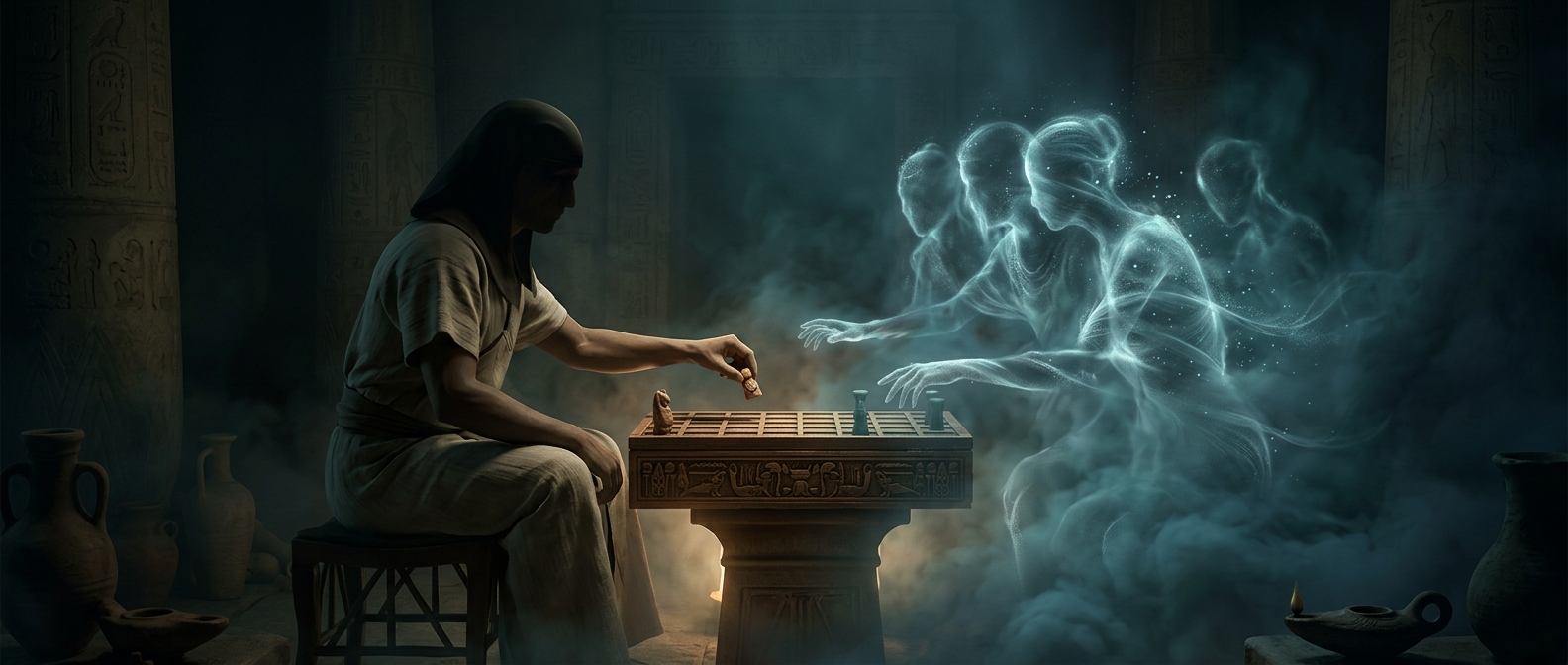
Boards and pieces have been found in Egyptian tombs, but their presence does not by itself prove that every early game was a ritual. The clearer religious connection appears in later evidence, especially in the New Kingdom, when paintings and funerary writings show the deceased playing Senet. The game could represent the dead moving through the underworld, with divine protection—including protection associated with the sun god Ra—at stake.
The shift did not require Egyptians to stop seeing Senet as a game. Its familiar moves made the afterlife’s uncertain journey visible and playable: a player advanced, met obstacles, and hoped to reach the end. The same board could serve as entertainment in life and as an image of passage beyond it, which is why Senet’s pieces and boards were meaningful objects to place among the dead.