What “spectral evidence” meant in Salem
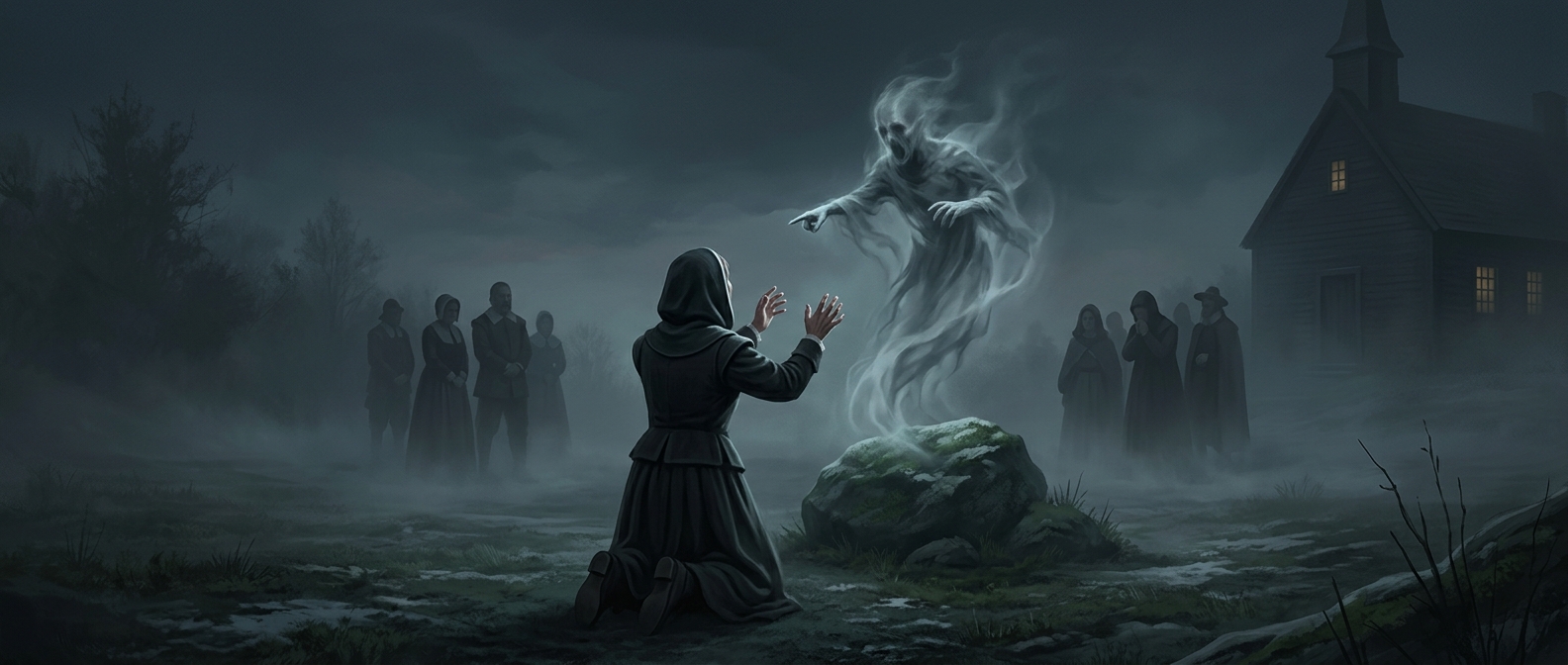
During the 1692 witch trials, some accusers said they saw an apparition—or “specter”—of a named person attacking or tormenting them. The accused person was not physically present in the room; the claim was that their spirit had appeared. In a culture that took witchcraft and the possibility of spiritual harm seriously, some authorities treated these accounts as evidence that a person had made a pact with the Devil.
An accusation difficult to answer
The central problem was that the alleged apparition was visible only to the accuser. A defendant could deny sending it, but could not produce a witness who had seen the same thing or show that it had never appeared. The testimony could also make ordinary behavior look incriminating: an accuser’s distress, or a reaction to someone in the courtroom, might be interpreted as proof that the person’s specter was present.
That did not make spectral claims the only evidence used. Trials also involved other testimony and, in some cases, confessions. But spectral evidence gave the accusations unusual force because it could point to a specific person without requiring a physical encounter or a publicly observable act.
The evidence became a point of dispute
As the crisis unfolded, the reliability of spectral testimony drew growing concern. If an apparition could be a deceptive spirit—or if a sincere accuser could be mistaken—then the claim alone could not securely identify who was responsible. The question was not merely whether the accuser had suffered, but whether that suffering proved the guilt of the person named.
That distinction mattered. When spectral evidence lost favor in later proceedings, convictions became harder to sustain. Salem’s trials show how a court can turn an experience that is private and impossible to check into public proof—and how difficult it is for the accused to challenge evidence with no independent witness.