How water can have two liquid forms
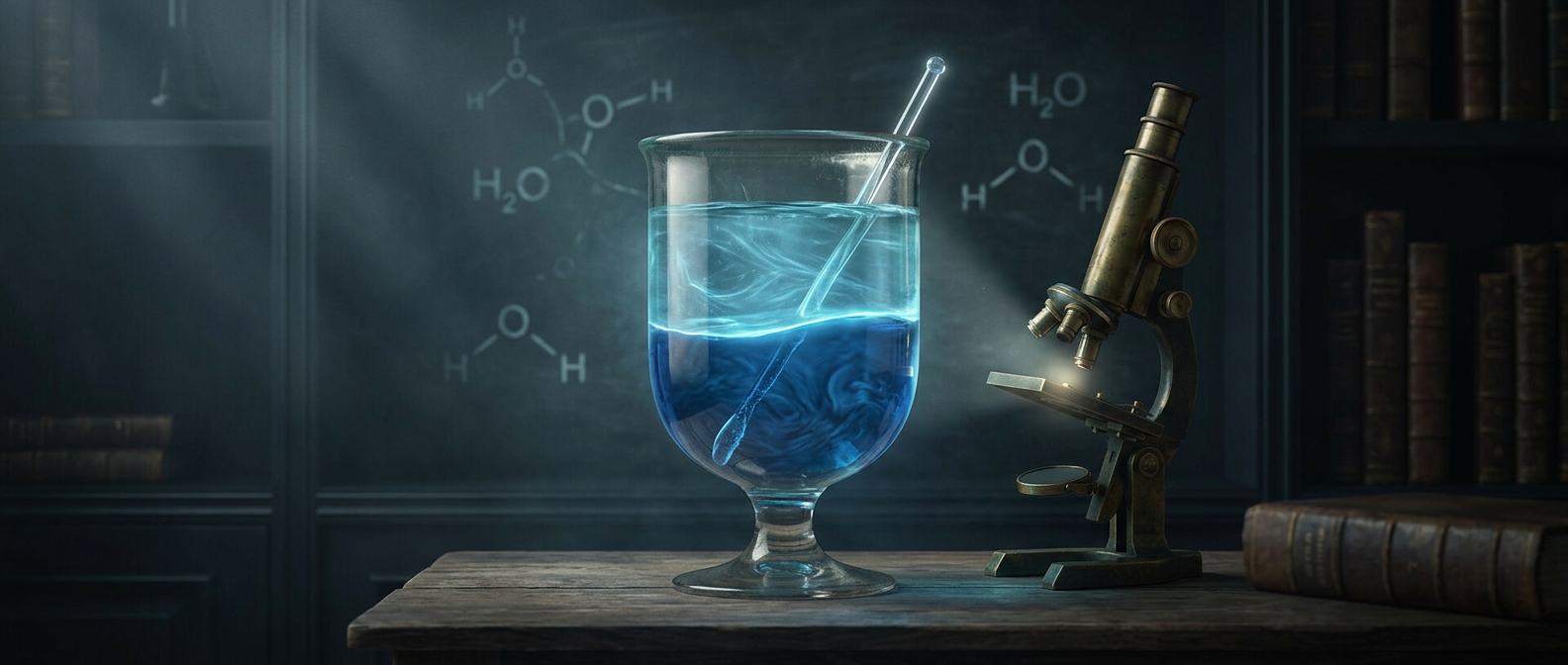
A liquid does not need a rigid crystal lattice to have distinct phases. In water, molecules are linked by shifting hydrogen bonds, and those bonds can organize into different patterns while the molecules continue to move past one another. Under extreme cold and pressure, water can separate into a less-dense liquid and a more-dense liquid—different arrangements of the same H₂O molecules, not liquid water and ice.
The distinction is subtle but physical. In the less-dense form, water’s hydrogen bonds favor a more open, ice-like local structure. In the denser form, the structure is more compact. Pressure can favor that compact arrangement, while cooling changes how readily the molecular network rearranges. Under the right conditions, the two forms can exist as separate liquid phases, much as liquid water and vapor are distinct phases under other conditions.
Why the experiment is so difficult
The catch is that the conditions needed to study this behavior also make ordinary ice formation a serious rival. As water gets extremely cold, its molecules move and rearrange more slowly; that gives ice crystals time to form and can erase the liquid state researchers are trying to examine. Pressure complicates the picture further by changing which molecular arrangements are favored.
Scientists therefore have to reach and probe the unusual conditions before crystallization takes over. The result matters because it shows that water’s familiar properties may come from a more complex liquid structure than a single, uniform arrangement. In the extreme, the same water can remain liquid while its molecular network shifts between forms with different densities.