How one molecular motor can twist its neighbors
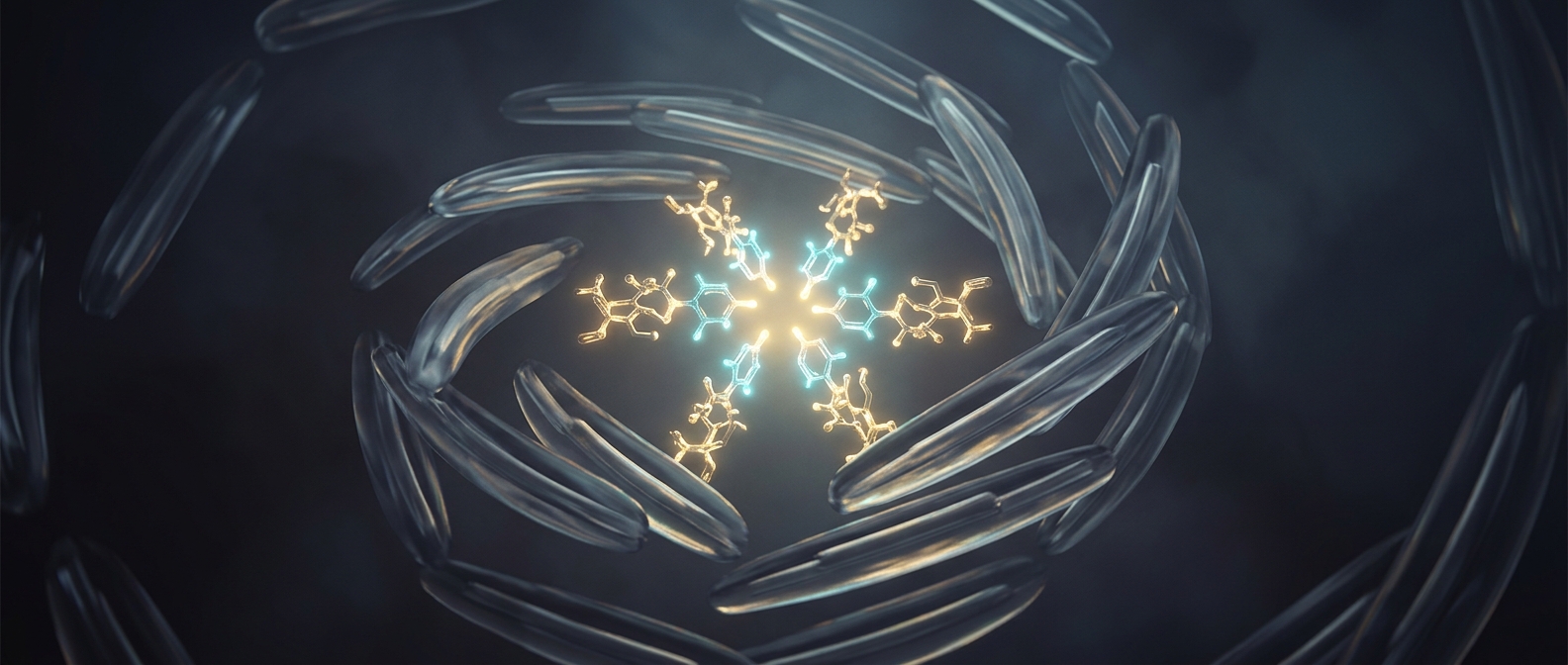
Liquid crystals are fluids whose molecules retain some order: instead of pointing every which way, many tend to align along a shared direction. That alignment can transmit a local disturbance. When one molecule changes orientation, the molecules packed beside it tend to adjust too, and their neighbors adjust in turn.
In some liquid-crystal systems, a light-sensitive molecular motor is linked into this orderly material. Ultraviolet light drives the motor through a rotation that favors one direction. As it turns, its shape and orientation disturb the local alignment, nudging nearby molecules to tilt. Their adjustments pass the twist outward through the surrounding material.
A changing pattern, not a tiny propeller
The result is a twist in the liquid crystal’s alignment pattern. It does not mean that one molecule physically pushes the entire liquid into spinning like a miniature fan. The motor supplies a local directional cue; the material’s shared molecular order spreads that cue into a larger-scale change in orientation.
How far the effect reaches depends on the liquid crystal and how its molecules interact. The key is that the motor is not acting alone: it is embedded in a medium where neighboring molecules are already inclined to coordinate. Light can therefore use one rotating molecule to set an organized crowd of molecules into a collective twist.