The embryo’s tail is a temporary construction
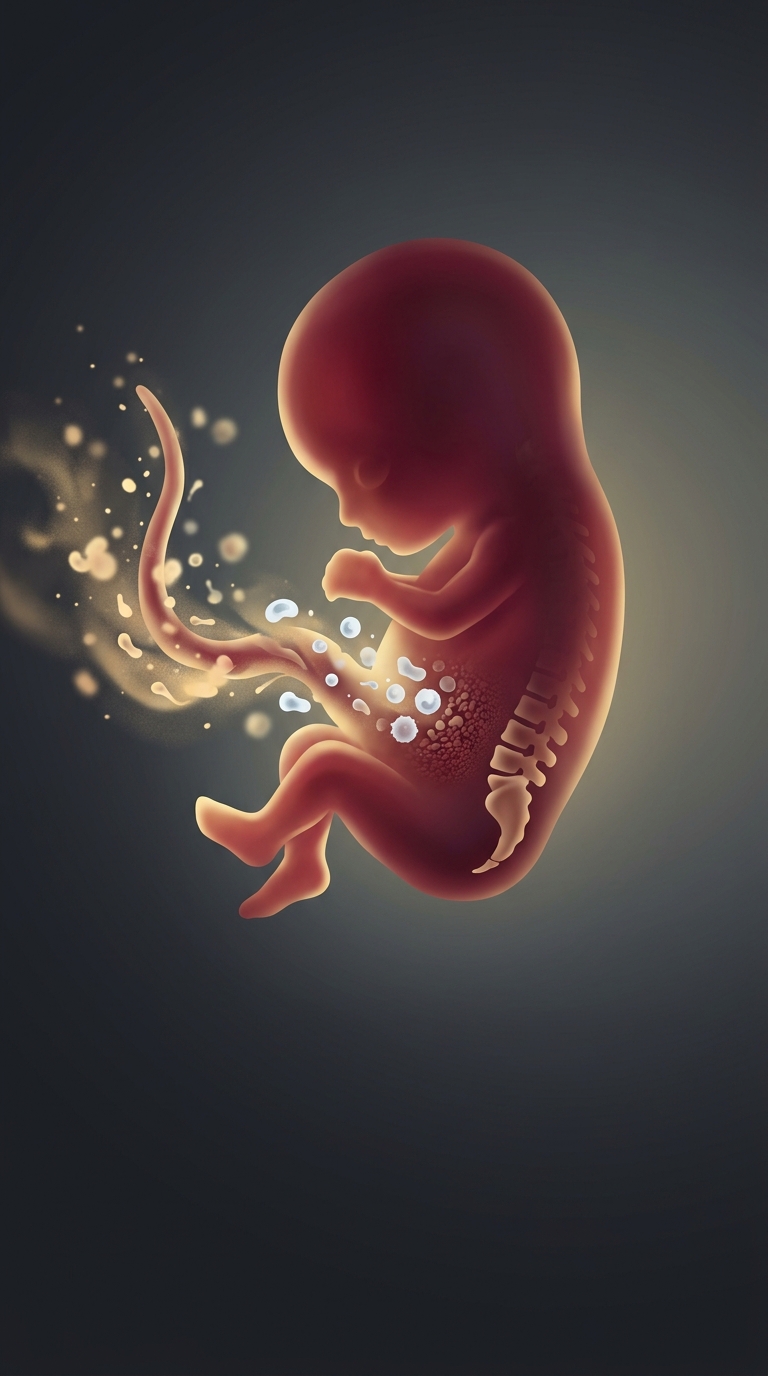
Early in development, the human embryo grows a small extension from its lower end. Around the sixth week, this tail-like region projects beyond the developing legs and contains several small, cartilage-forming or vertebra-like segments. It is part of the body’s normal developmental sequence—not a fully formed animal tail waiting to be switched on.
How it disappears
As development proceeds, cells in the tail region undergo apoptosis, a controlled form of cell death used to shape many parts of the body. The dead cells are then cleared by nearby cells, including macrophages—immune cells that act like cleanup crews by engulfing cellular debris. This is not the immune system recognizing a mistake and attacking the embryo; it is a routine remodeling process directed by developmental signals.
Over the following weeks, the projecting tail regresses. Its outer tissues are absorbed, while the lower end of the skeleton is reshaped. The coccyx, or tailbone, consists of small vertebral segments that fuse to varying degrees; it is related to the same lower-end skeletal region, though it is not simply an intact tail left behind.
A brief stage, not a missed feature
The timing matters: the tail-like extension appears before the embryo’s body plan has finished taking shape, then recedes as the lower trunk and limbs develop. By the time a fetus is much further along, the external extension is gone. What remains is a compact bony structure at the base of the spine, where muscles and ligaments attach—a reminder that development often builds a temporary structure, then remodels it into something with a different role.