A familiar face with an uncanny shadow
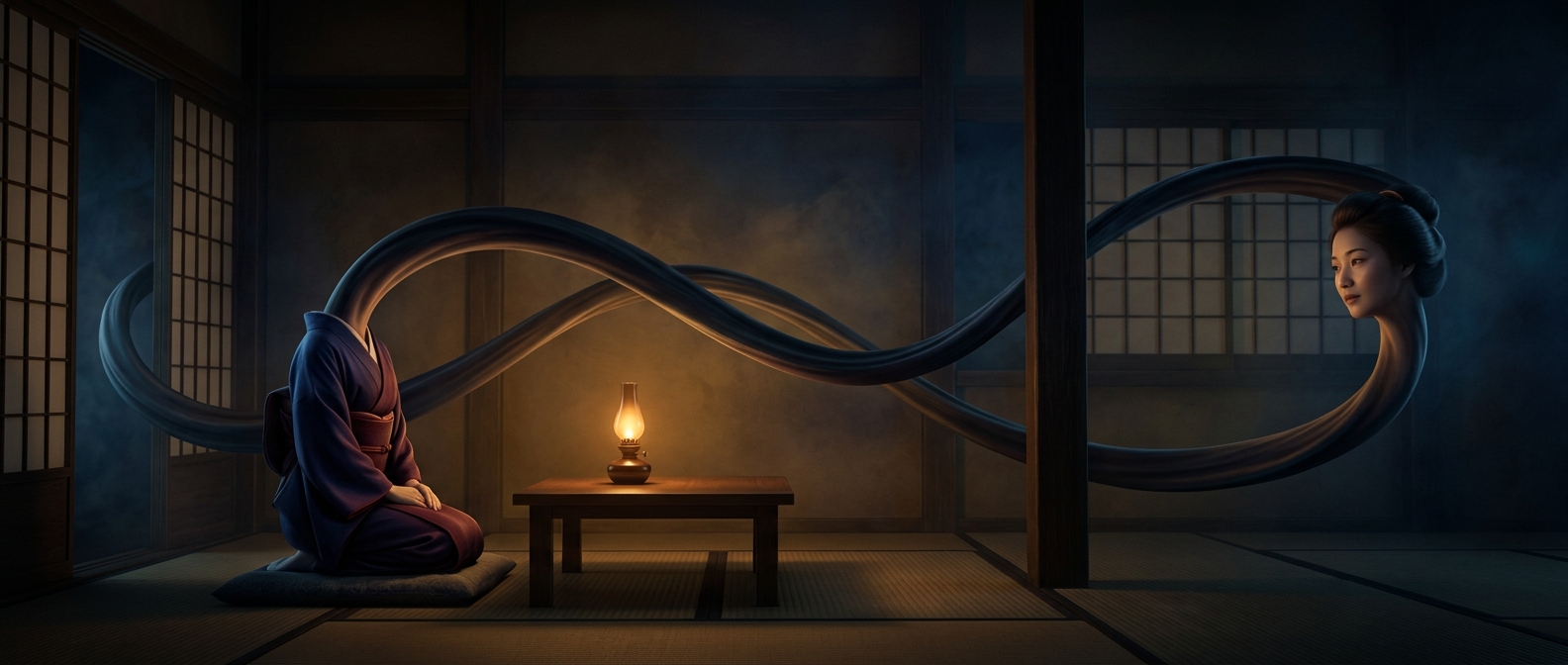
In Japanese folklore, a rokurokubi is a person—often portrayed as a woman—whose neck lengthens supernaturally, especially at night. The head remains attached as it glides away from the body, peering into rooms or reaching places an ordinary person could not. The transformation makes the creature unsettling precisely because it begins with someone who seems entirely human.
Rokurokubi are sometimes confused with nukekubi, another kind of supernatural being whose head separates from the body and flies off. In the rokurokubi’s stories, the impossible stretch itself is the signature: a familiar human shape becomes bizarre without fully breaking apart.
Why the stretch matters
The long neck turns a private nighttime space into an exposed one. A head can drift above a screen, peer across a room, or appear where no person could stand, making ordinary barriers—walls, doors, the distance between rooms—feel suddenly unreliable. The image also lets a story play on uncertainty: someone may look harmless by day, while darkness reveals a hidden nature.
Tales vary, so the creature does not carry one fixed explanation or moral. In some tellings, the transformation is treated as a strange condition; in others, it is part of a ghostly or frightening encounter. What remains consistent is the contrast between an ordinary appearance and an impossible body. A rokurokubi needs no elaborate monster shape: one familiar face, quietly drifting near the ceiling, is enough to make an entire room feel unsafe.