When Repetition Becomes a Programming Language
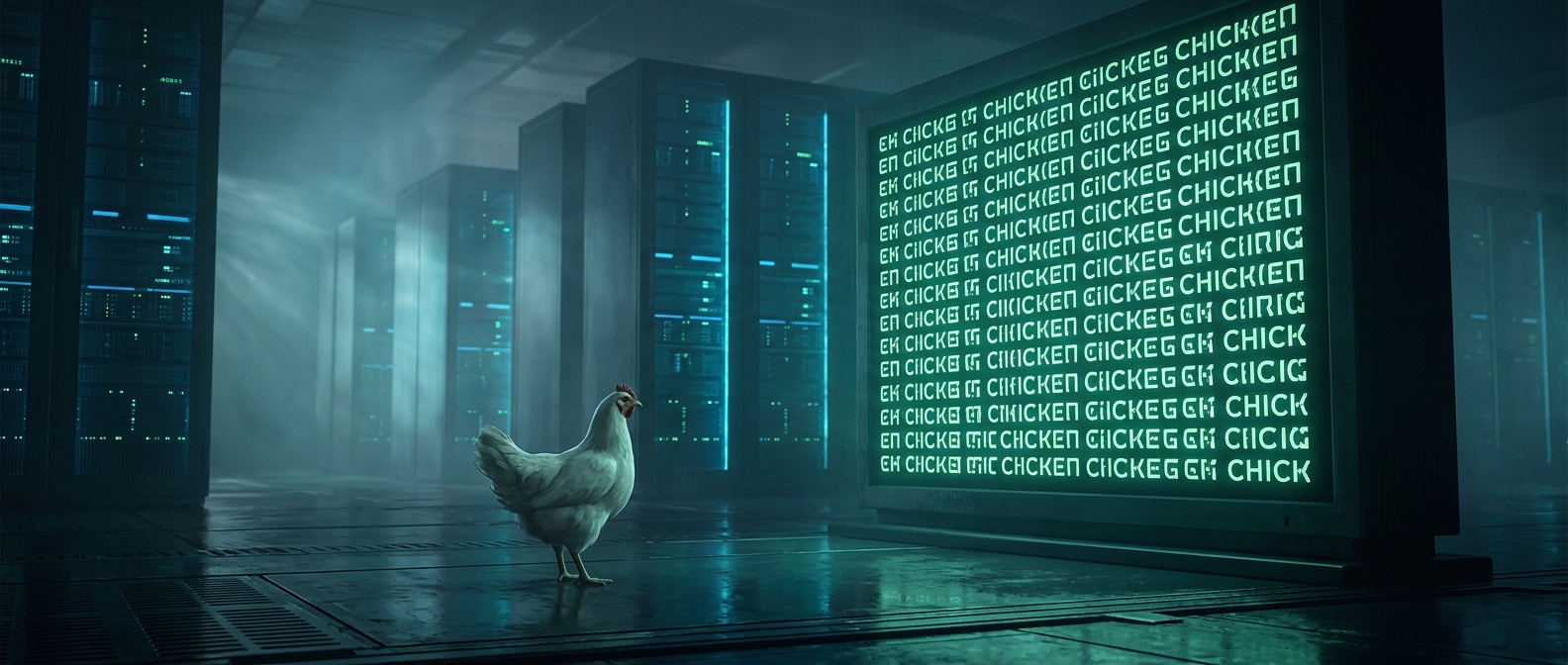
In this deliberately strange programming language, “chicken” is not a word with a different meaning each time. It is a token: the interpreter recognizes the repeated word, counts how many times it appears, and uses that count to decide what the instruction means. The visible code can look like a joke or a chant, but underneath it is a compact set of rules connecting written patterns to computer operations.
The Count Is the Code
That design shifts the burden of meaning from vocabulary to quantity. A reader does not need to learn dozens of command names; the key is knowing how each count maps to an action. Change the number of repetitions, and the program may perform a different operation. The interpreter makes this possible by treating the text as structured input rather than ordinary prose.
Languages built around playful constraints like this are often called esoteric programming languages. They are made less to serve everyday software development than to explore what counts as a programming language, or to make familiar computing ideas feel surprising. The constraint is also the joke: a tiny, repetitive vocabulary can still carry instructions once a precise system gives it meaning.
A Joke With Working Rules
The word itself does not make the computer understand chickens. The language’s rules do. That distinction is the useful trick: programming depends not on how sophisticated a command looks, but on whether its symbols can be interpreted consistently. Here, counting a string of identical words turns an apparently absurd line into something a machine can act on.