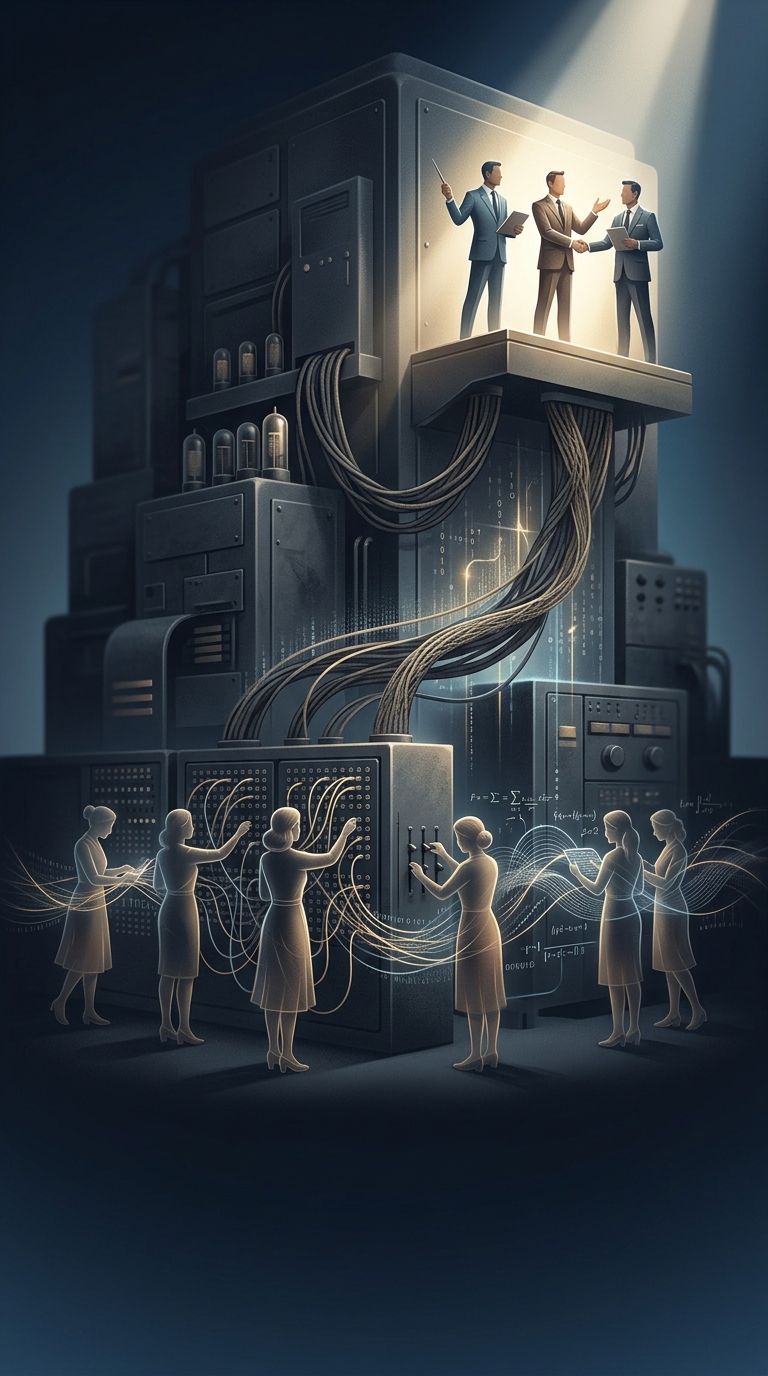
A machine designed to follow instructions
Charles Babbage’s proposed Analytical Engine was more than a calculator. Its design included a “store” for holding numbers and a “mill” for carrying out arithmetic—roughly the roles of memory and a processor in a modern computer. Punched cards, adapted from those used to control patterns in looms, were meant to tell the machine which operations to perform and in what order.
The engine was never completed, so no one could test a program on it. But its detailed design gave Ada Lovelace something concrete to reason about: a machine that could repeat operations and handle a sequence of instructions, rather than merely perform a single calculation.
Turning a mathematical method into a program
In 1843, Lovelace published a translation of an account of the engine, adding extensive notes of her own. One note laid out a sequence of operations for calculating Bernoulli numbers, a particular set of values used in mathematics. The plan included repeated steps and intermediate results—the kind of procedure that could, in principle, be carried out by the engine.
That is why she is widely called the first computer programmer: she described an algorithm intended for a general-purpose machine before such a machine existed. The distinction matters. Lovelace did not build or run the engine, and the algorithm remained a plan on paper, but her notes showed how its instructions could be organized to produce a result.
From numbers to music
Lovelace also recognized a consequence of the engine’s design that went beyond arithmetic. If a machine could manipulate symbols according to rules, then numbers did not have to stand only for quantities. They could represent other things—such as musical notes—provided those things could be encoded in a suitable system and the machine given instructions for working with them.
The engine therefore suggested a broader possibility: a machine might handle music or other symbolic material, not because it understood meaning, but because it could follow a structured set of rules. That leap—from calculating numbers to manipulating representations—is what makes Lovelace’s notes notable even though the machine itself never left the plans.