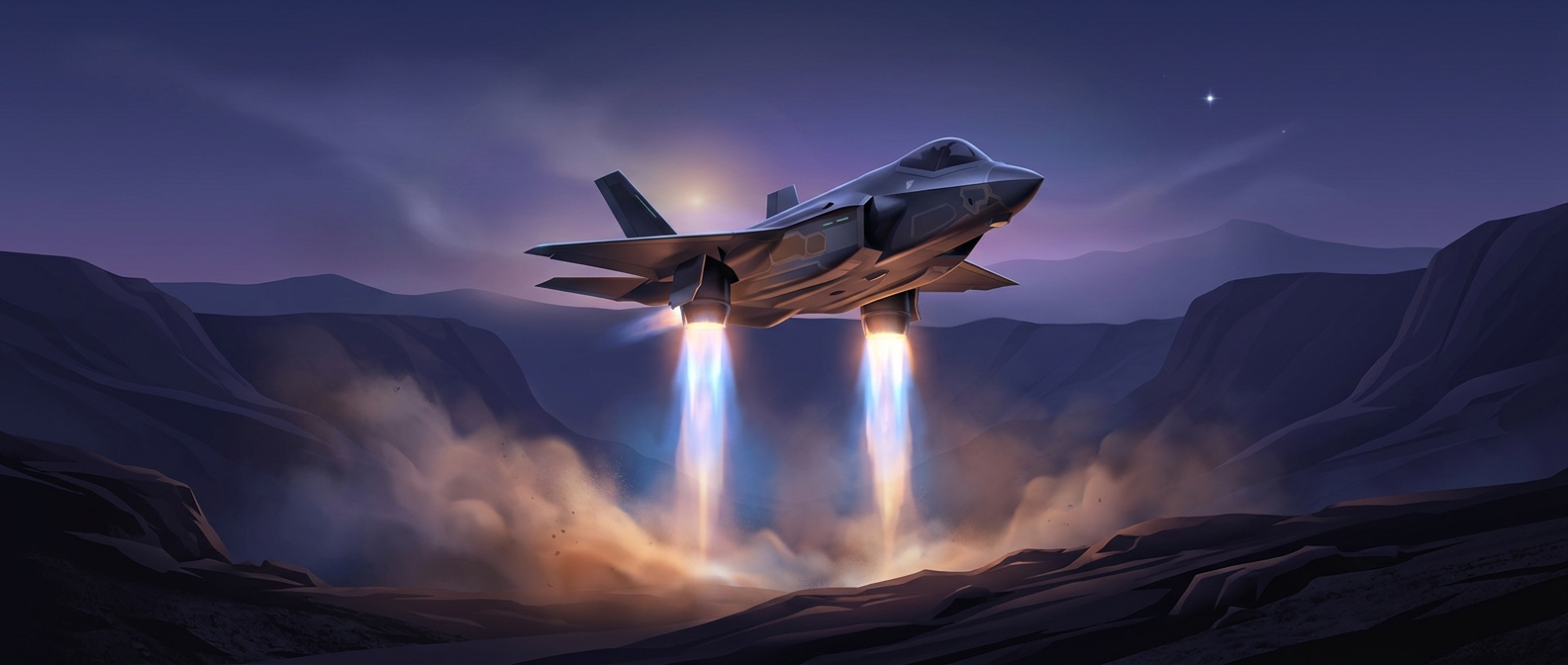
Hovering means changing what holds the aircraft up
A conventional jet gets most of its lift from its wings: as the aircraft moves forward, air flowing around the wings creates an upward force. At a standstill, that airflow largely disappears. A jet that can hover must instead produce enough upward-directed thrust to support its weight—and keep that force balanced across the aircraft so it does not tip or drift.
That ability is built into only certain designs. In a Harrier, rotating engine nozzles turn the exhaust downward. The F-35B uses a different arrangement: a fan behind the cockpit supplies additional downward thrust, while a swiveling rear nozzle directs engine exhaust down. In both cases, the aircraft’s flight controls adjust the thrust at different points to steady it.
The difficult part is the changeover
Hovering is only one mode of flight. To move forward, the pilot gradually redirects thrust backward and accelerates until the wings can provide useful lift. The aircraft must pass through this transition without losing too much lift or becoming unstable, so specialized controls help manage the change.
The downward blast also creates practical constraints. It is extremely hot and powerful, which can damage surfaces below the jet; hovering therefore requires suitable space and careful handling. The striking engineering tradeoff is that the aircraft carries machinery for two different ways of staying aloft: wing lift in forward flight and redirected engine thrust when nearly stationary.