Two effects compete in orbit
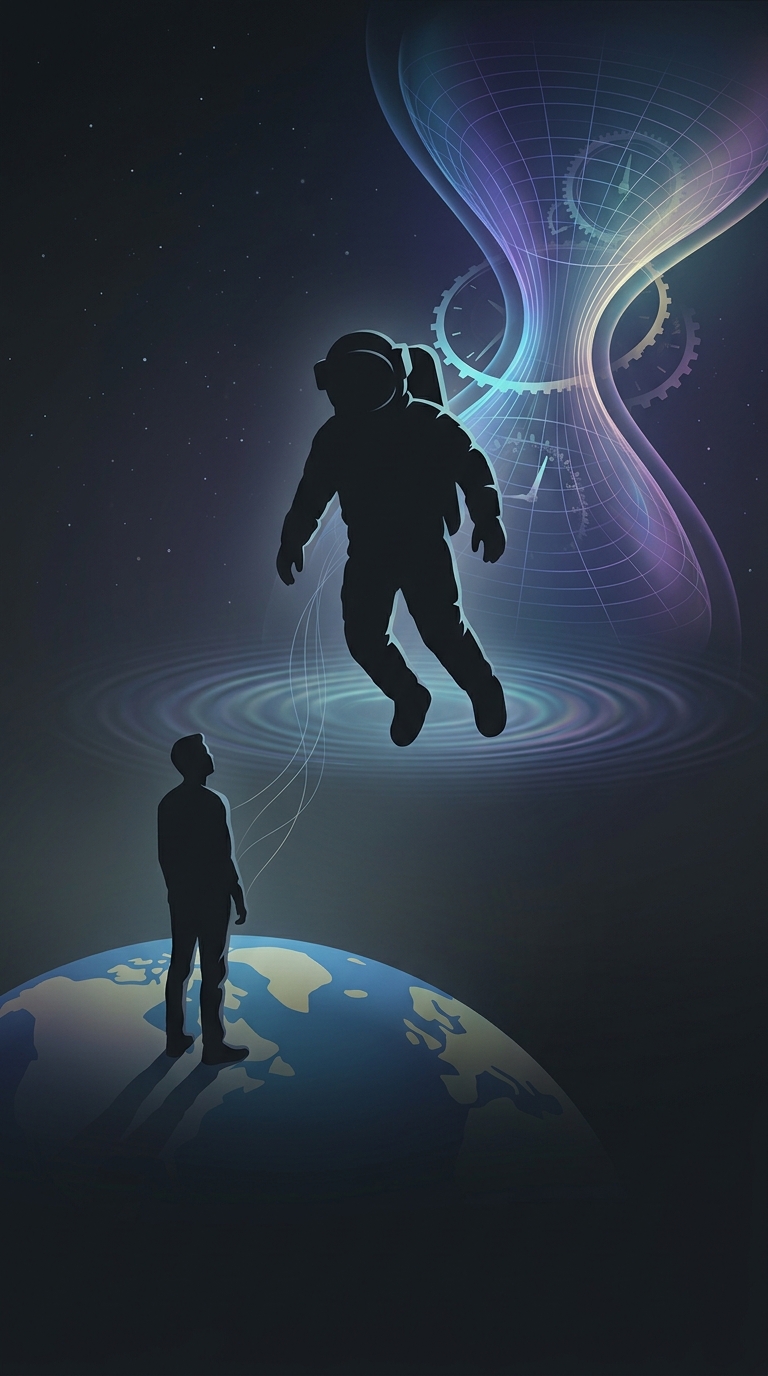
An astronaut’s body does not stop aging in space. Instead, relativity predicts that the astronaut’s elapsed time can differ slightly from the time elapsed for someone on Earth. Two effects pull in opposite directions aboard the International Space Station (ISS).
First, moving clocks run slower relative to clocks at rest in the same reference frame. The ISS circles Earth at roughly 7.7 kilometers per second, so its speed makes time pass more slowly for its crew than for people on the ground.
Higher up means faster clocks
Gravity has the opposite effect. In Einstein’s theory of general relativity, clocks deeper in a gravitational field tick more slowly than clocks farther away. The ISS is hundreds of kilometers above Earth’s surface, where gravity is slightly weaker, so its clocks tick faster than ground clocks would if they were otherwise at rest relative to one another.
For the ISS, the speed effect is larger than the altitude effect. The combined result is that astronauts accumulate a little less time than people on Earth: after a typical six-month mission, the difference is only a few milliseconds.
A real difference, not a change in biology
Nothing about orbit makes an astronaut’s cells age in a special way. The difference comes from how much time passes along each person’s path through space and time. If an astronaut and a person on Earth later compared clocks, the astronaut’s clock would have recorded slightly less elapsed time—and, in that precise sense, the astronaut would be slightly younger.