Why airplanes need a steady supply of outside air
At cruising altitude, the air outside an airplane is too thin and cold to breathe as it is. The aircraft’s environmental-control system compresses outside air, warms or cools it, and regulates its pressure before sending it into the cabin. This incoming air is one part of the cabin’s supply; another part is air drawn from the cabin, filtered, and mixed back in.
The system has to keep replacing air as passengers breathe and release heat and moisture. Simply circulating the same air indefinitely would allow carbon dioxide and other gases to build up, and would make temperature and humidity harder to control.
What recirculation adds
A high-efficiency particulate air filter, usually called a HEPA filter, traps very small airborne particles as recirculated air passes through it. That includes many particles that can carry germs, though a filter does not remove every gas or make transmission impossible. Fresh outside air and filtered recirculation work together: one continually renews the cabin’s air, while the other lets the system move and condition it efficiently.
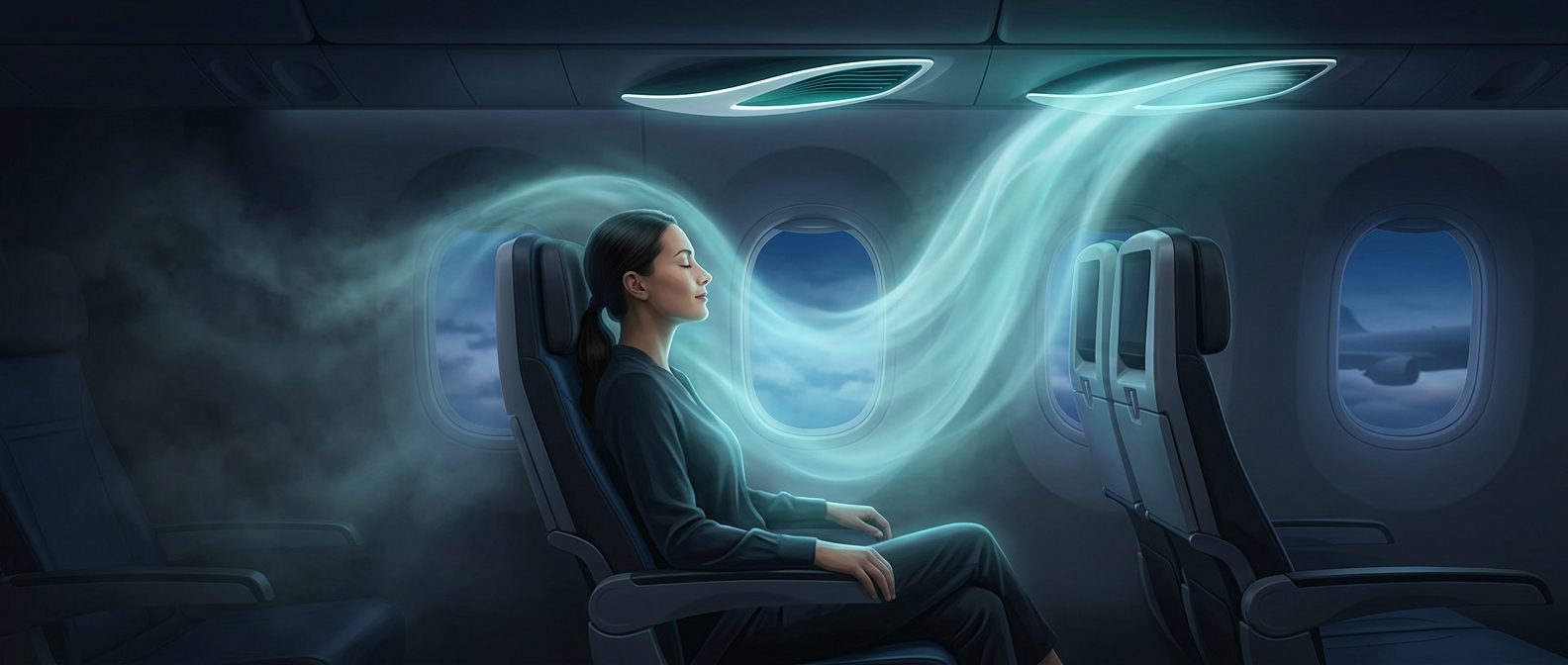
Cabin air is generally directed from overhead outlets toward floor-level returns, rather than being pushed from one end of the cabin to the other. That limits broad front-to-back airflow, but people sitting close together can still share air at short range. The practical point is that cabin air is neither simply reused unchanged nor instantly made risk-free: it is continuously managed through a combination of outside-air supply, filtration, and controlled airflow.