A railway has to fit the train’s physics
At speed, a train cannot turn as sharply as a car. Its wheels are guided by the rails, so a tight bend would create strong sideways forces on passengers and on the track. Engineers ease those forces by banking the track slightly and spreading each turn over a long distance. But that means the route must begin bending well before it reaches an obstacle—and keep bending after it passes one.
Grades pose a different constraint. Steel wheels rolling on steel rails offer little grip, which makes steep climbs harder, especially for long trains. A route that rises gradually may need to travel much farther than the terrain’s direct uphill path.
One obstacle can reshape miles of route
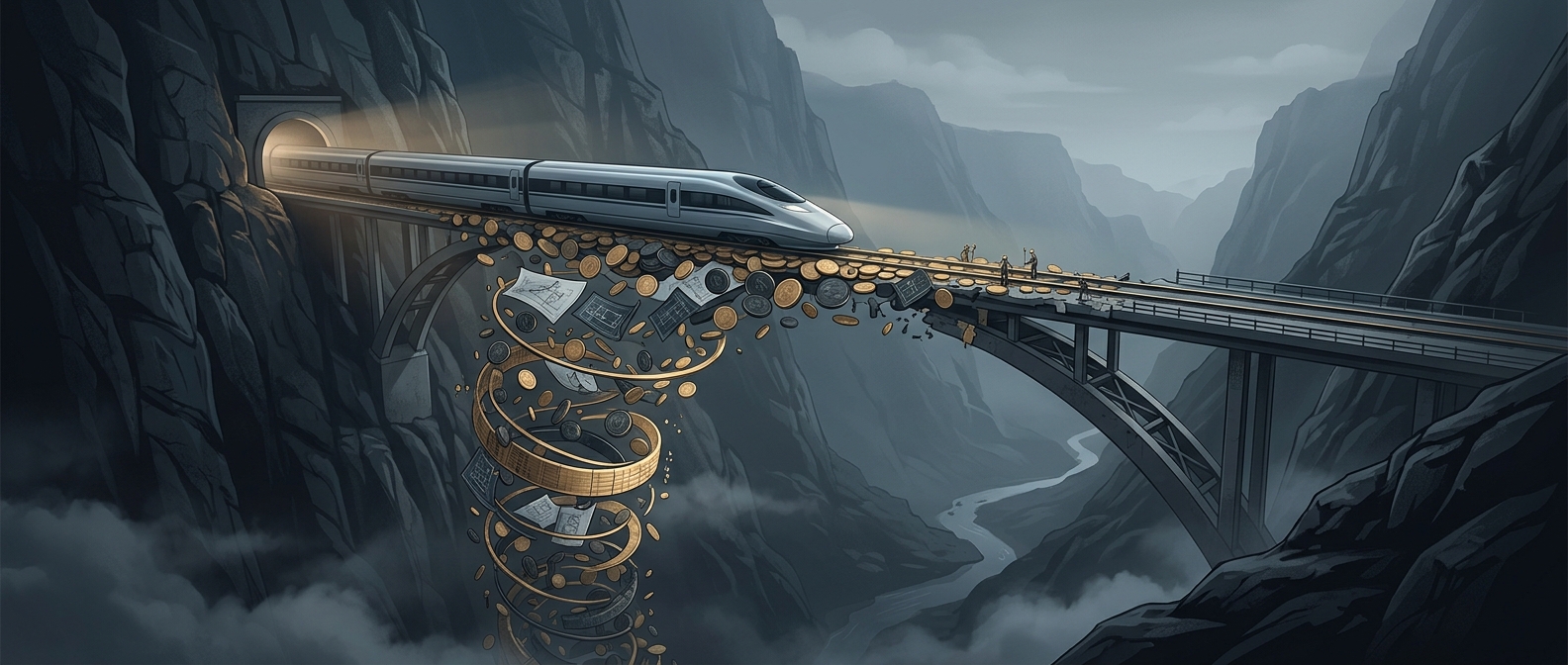
When a proposed line meets a ridge, river, or built-up area, engineers compare ways around or through it. A tunnel can preserve a smooth path through a hill, but requires excavation, drainage, ventilation, and safety systems. A bridge can carry the track over a valley, but its foundations and structure must support a heavy train while keeping the rail line accurately aligned.
Avoiding major structures is not automatically cheaper. A detour can add land purchases, construction, and travel time, while forcing new curves that make the line less useful. In developed areas, finding a continuous strip of land may mean relocating roads or utilities and negotiating with many property owners.
The route is a chain of linked decisions
A railway cannot be designed as a series of independent shortcuts. A bend chosen to avoid one neighborhood may push the next section toward a tunnel; shifting that tunnel may require a longer bridge or a new approach. The alignment—the track’s precise path across the landscape—has to work as one continuous whole.
That is why a relatively small map line can demand so much construction: the project is not simply laying rails between two cities. It is creating a path that the train can safely follow at speed, even where the land and existing development do not offer one.