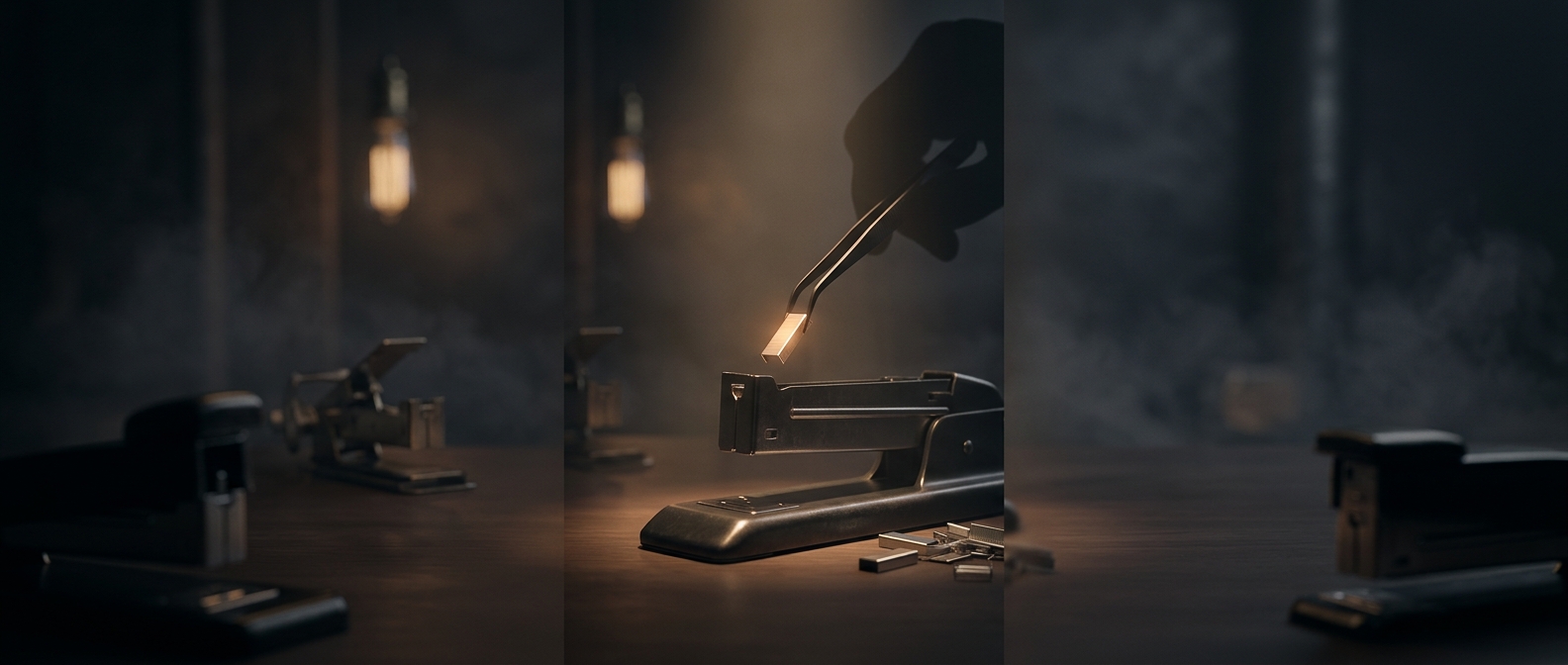
How a Row of Staples Changed the Stapler
A modern strip of staples is more than a bundle of fasteners: it turns a series of separate loading steps into one continuous supply. Small deposits of adhesive hold the staples together in a straight row. The adhesive keeps the strip intact in the stapler but is weak enough to break as the mechanism drives staples out one by one.
From Reloading Each Staple to Feeding the Next
Inside the stapler, a narrow magazine supports the strip. A spring-loaded pusher presses it toward the front, keeping the next staple in position. When the handle is pressed, a driver forces the front staple through the paper; as the handle rises, the pusher advances the remaining row.
With loose staples, someone had to place each one into position before it could be used. A strip lets the tool do that positioning automatically. The difference is small for a single sheet, but it matters when fastening many pages: fewer interruptions mean less time spent handling supplies and more predictable operation.
The Design Tradeoff
The strip has to be firm enough to survive loading and feeding, yet easy for the driver to separate one staple from the next. That balance makes the staples work as a unit only until they reach the firing point. A simple office tool therefore depends on coordination between the strip’s adhesive, the magazine’s guide, the spring, and the driver.
The lasting change was not that staples became different fasteners; it was that they could be presented to the mechanism as a ready-to-feed row. A task once repeated with every staple became a single reload followed by a sequence of presses.