Why low notes can travel farther
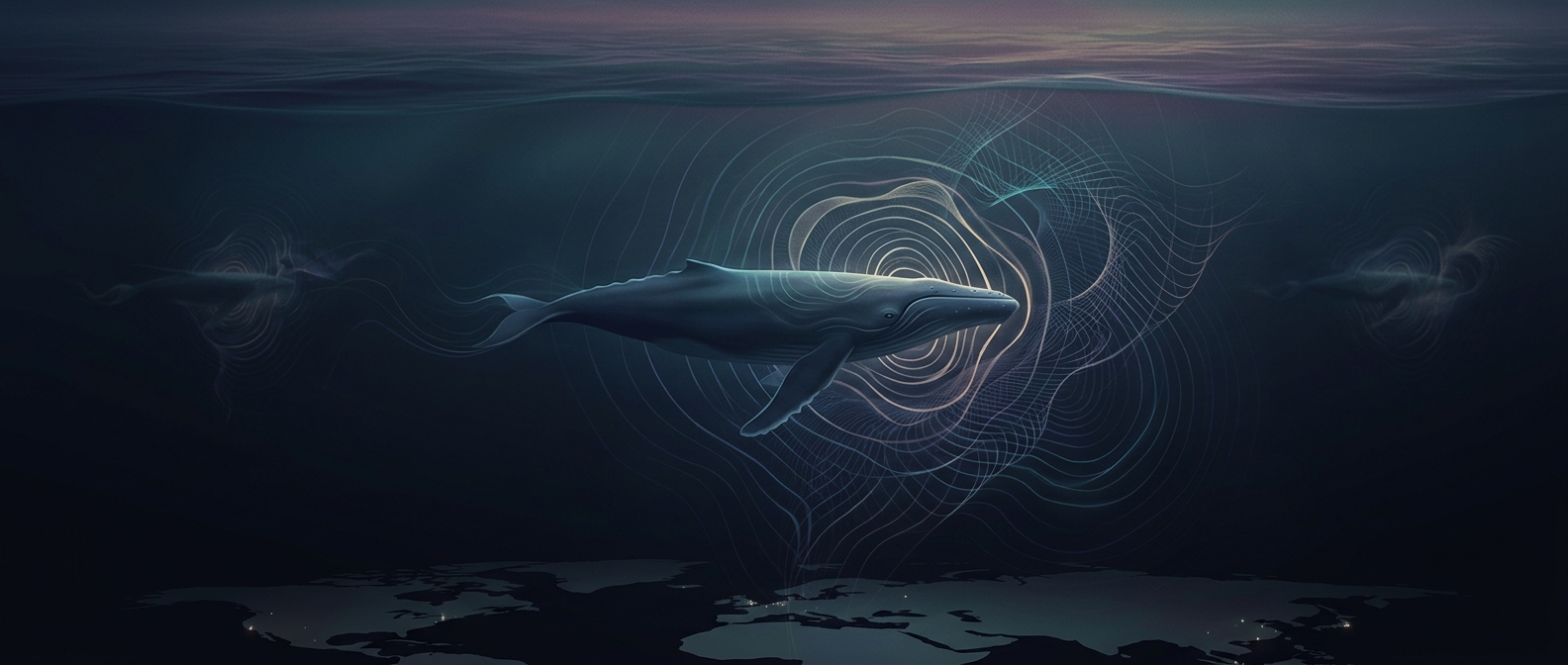
A whale’s call moves through water as a pressure wave: particles of water nudge neighboring particles, carrying the sound onward. High-pitched sounds generally lose more energy to absorption, while low-frequency sounds can remain detectable over greater distances. Their long wavelengths also make them less easily scattered by small irregularities in the water.
That does not mean a low call simply travels in a straight line. The speed of sound changes with temperature, pressure, and salinity. In some parts of the ocean, those changes bend sound back toward a depth range where it can keep traveling—a natural acoustic pathway often called the deep sound channel. A call entering that pathway may cover far more distance than one sent through water where the sound spreads or escapes upward and downward.
Distance is not the same as reception
As a call travels, its energy spreads across a larger area, making it fainter. Other sounds—from waves, weather, ships, and marine life—can also obscure it. A whale’s call may therefore be physically present at a distant location but too weak or masked for another animal to detect reliably.
The result is a communication range that depends on the call, the ocean conditions, and the listening animal—not a fixed radius around the caller. Under favorable conditions, a low call can link distant parts of the ocean acoustically, even though it cannot guarantee that any particular whale hears it.