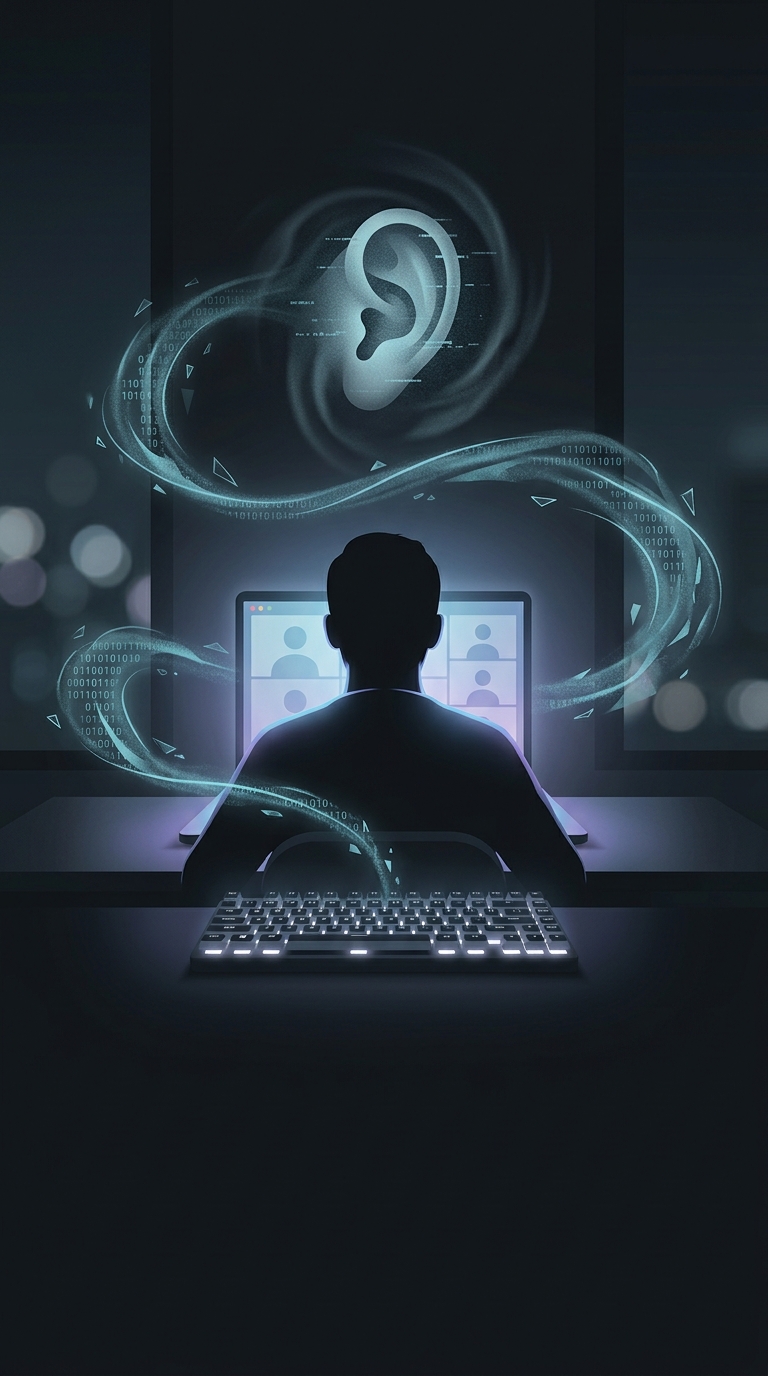
A keyboard can leave a sound-based trail
A mechanical keyboard does more than send a signal to a computer: each press also makes a small, characteristic sound. The pitch and sharpness can vary with the key, the keyboard’s construction, and how it is struck. If that sound reaches a video call, a listener with access to the call’s audio may be able to analyze it and infer what was typed—including, in principle, a password.
This is an acoustic side channel: information leaks through an unintended signal, in this case sound, rather than through the computer’s files or network traffic.
How sound can become text
A recording does not label each click with a letter. An attacker would need to distinguish the sounds, map them to likely keys, and use the rhythm and surrounding patterns to make sense of the sequence. Software trained on recordings can help classify keypresses; language patterns can help resolve ambiguous ones. A password is harder to guess from context than an ordinary sentence, but its individual keystrokes may still provide clues.
The attack is not automatic or guaranteed. It depends on getting usable audio: call noise suppression, microphones, room acoustics, typing speed, and the particular keyboard can all blur the differences. A recording of someone typing is not necessarily enough to reconstruct everything they entered.
The weak link is the microphone
The risk comes from treating call audio as if it carries only speech. A microphone can also pick up typing, and anyone who can hear or record that audio may have more information than the typist intends to share. Muting while entering sensitive text, or using a quieter keyboard, reduces the sound available to analyze.
The unsettling implication is simple: a password can leak without appearing on screen or being sent in a message. Sometimes the clue is the sound of entering it.