How a gas becomes a shared quantum state
In an ordinary gas, atoms zip around with a range of speeds and directions. Their quantum wave patterns—the spread-out descriptions of where each atom might be—overlap only weakly, so the gas behaves like a swarm of separate particles.
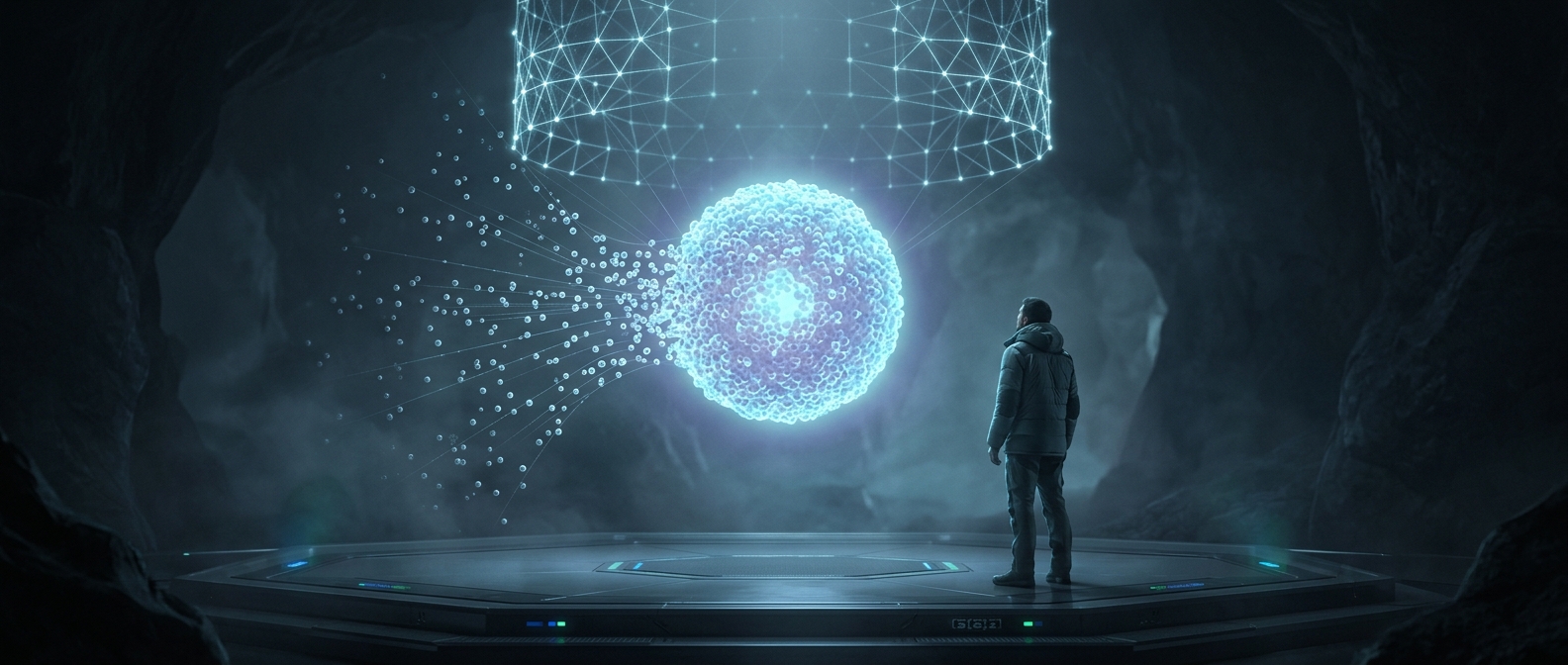
Cooling changes that. Slower atoms have wave patterns that spread farther. At sufficiently low temperatures and high enough density, those patterns overlap extensively. For atoms that are bosons, many particles can occupy the same lowest-energy quantum state. The result is a Bose–Einstein condensate: a cloud whose atoms are described collectively by one coherent matter wave.
The last step is cooling away the fastest atoms
Researchers typically first use laser light to slow atoms, then trap them with magnetic or optical fields. They cool the trapped cloud further by letting its most energetic atoms escape. The remaining atoms redistribute their energy at a lower temperature, much like steam escaping from a hot cup leaves the liquid cooler. Repeating this process can bring a dilute gas close to absolute zero without freezing it into an ordinary solid.
At that point, the atoms have not fused or become indistinguishable lumps. They remain separate particles, but their shared quantum state makes their behavior coordinated. A disturbance can affect the cloud as a whole, and two condensates can produce an interference pattern when brought together—evidence that their matter waves have a definite relationship in phase.
A laboratory-sized glimpse of quantum behavior
Quantum effects usually dominate at the scale of atoms; a condensate makes them visible across a much larger cloud. It gives physicists a controllable way to study wave behavior, collective motion, and how a quantum system changes when disturbed. The striking part is not that the atoms stop being individuals, but that thousands can move according to one shared wave.