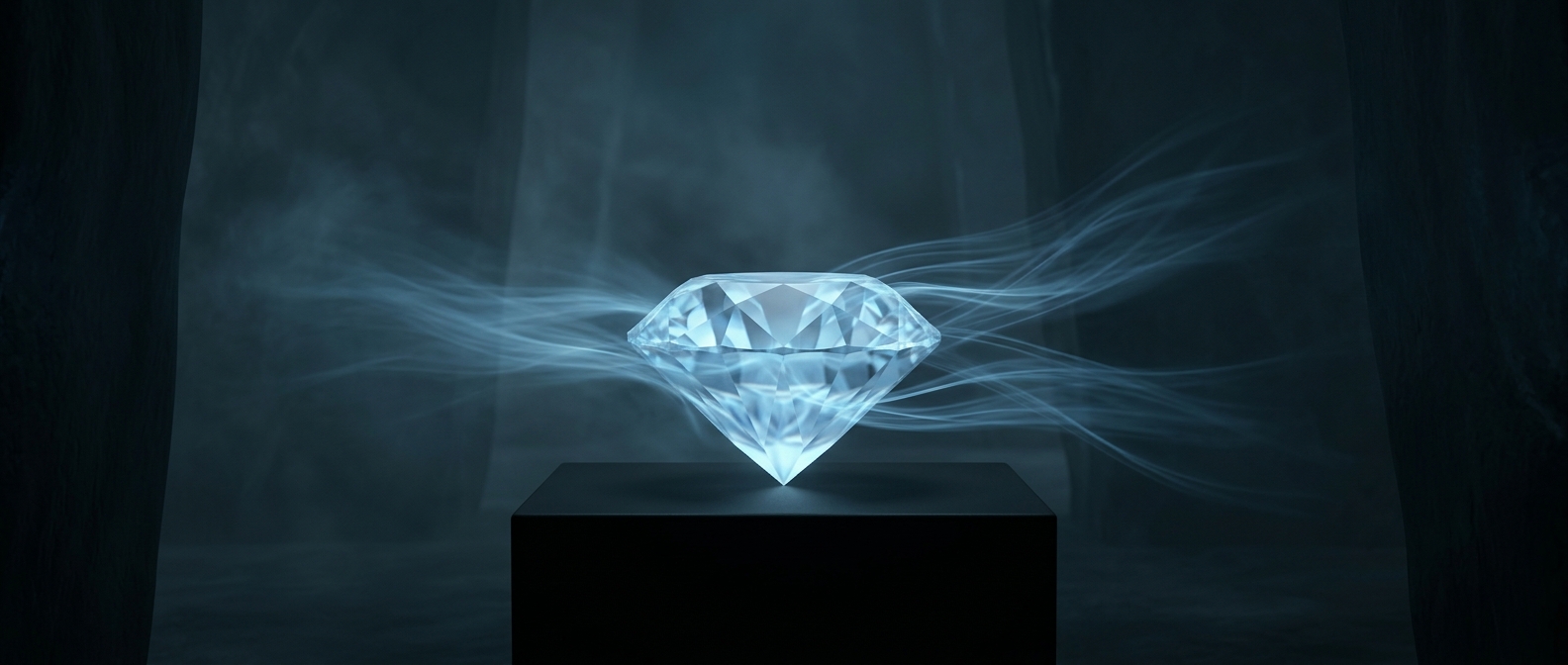
A crystal with two different electrical worlds
In a bismuth–antimony topological insulator, the interior and the surface behave differently: the bulk has an energy gap that makes it hard for electrons to carry current, while the crystal’s surface supports conducting electronic states. The surface is not a separate coating. Its unusual behavior follows from the material’s quantum-mechanical band structure—the allowed energy states electrons can occupy.
The key idea is topology: a mathematical property of the band structure that cannot be changed smoothly without closing the energy gap or otherwise changing the material’s state. At the boundary between this topological material and ordinary space, conducting states appear. They are often compared to a protected edge in a map: changing the boundary’s small details does not simply erase the route.
Why some defects have less effect
Surface electrons in these materials can have their direction of motion linked to their spin, an intrinsic quantum property. This is called spin–momentum locking. In an ideal, nonmagnetic surface, an electron cannot easily reverse direction through ordinary scattering, because reversing its motion would require changing its spin in a way that the relevant symmetry forbids.
That protection is real, but it is not immunity from every impurity or disturbance. Electrons can still scatter in other ways, and magnetic defects or external conditions that break the protecting symmetry can weaken the effect. The surface also conducts at finite speeds and can dissipate energy; it does not carry current at the speed of light or guarantee zero heat.
A useful route for quantum devices
The appeal is that surface current may be less vulnerable to certain kinds of disorder than current in an ordinary conductor. Researchers can study and engineer that behavior for potential electronic and quantum technologies. Turning it into a practical device still requires controlling the surface, the bulk, and unwanted scattering. The striking feature is not a flawless wire, but a material whose underlying quantum structure helps keep a conducting path at its boundary.