How diamond moves heat without making it
A diamond does not generate warmth when it touches ice. Instead, it can carry heat already present in its surroundings toward the tiny area where diamond and ice meet. That makes the contact point melt faster than it otherwise would, allowing a heavy diamond to sink or “cut” downward through ice.
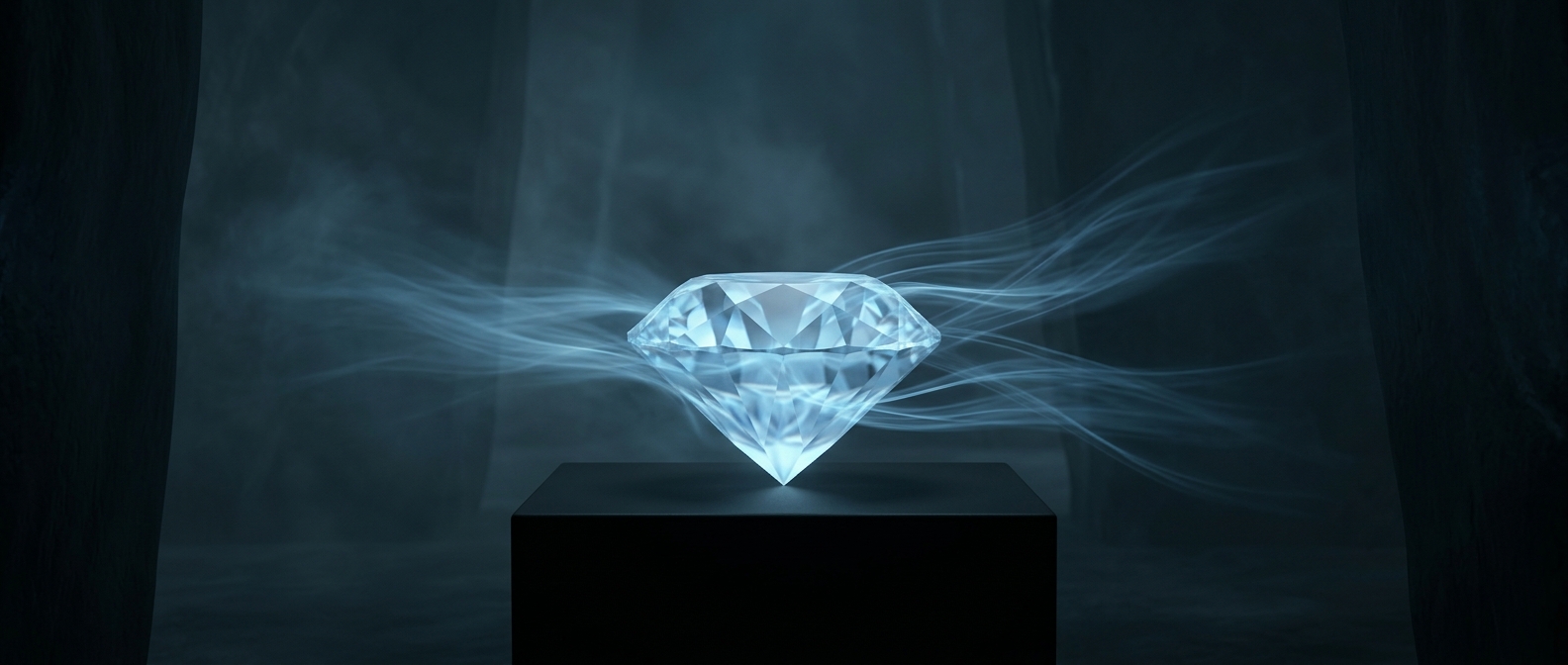
The key is how heat travels through the crystal. In a solid, atoms jiggle around fixed positions. Those motions can pass along as vibrations, transferring energy from one part of the material to another. In diamond, strong bonds between carbon atoms form a very orderly structure, so these vibrations travel unusually well rather than being scattered at every turn.
A clear route through a crystal
This efficient transfer depends on diamond’s crystal lattice: the repeating, tightly connected arrangement of its atoms. When one region is warmer than another, energy moves through that lattice toward the cooler region. At the ice contact, the arriving energy helps melt a thin layer; the diamond then advances into the newly softened space.
The effect is a vivid demonstration of thermal conductivity—how readily a material transfers heat. It does not mean diamond is hot, nor that it supplies energy by itself. The surrounding environment must provide the warmth, and the diamond serves as a remarkably effective route for delivering it to a small contact point. That distinction is what makes the ice-cutting effect possible without turning the diamond into a heater.