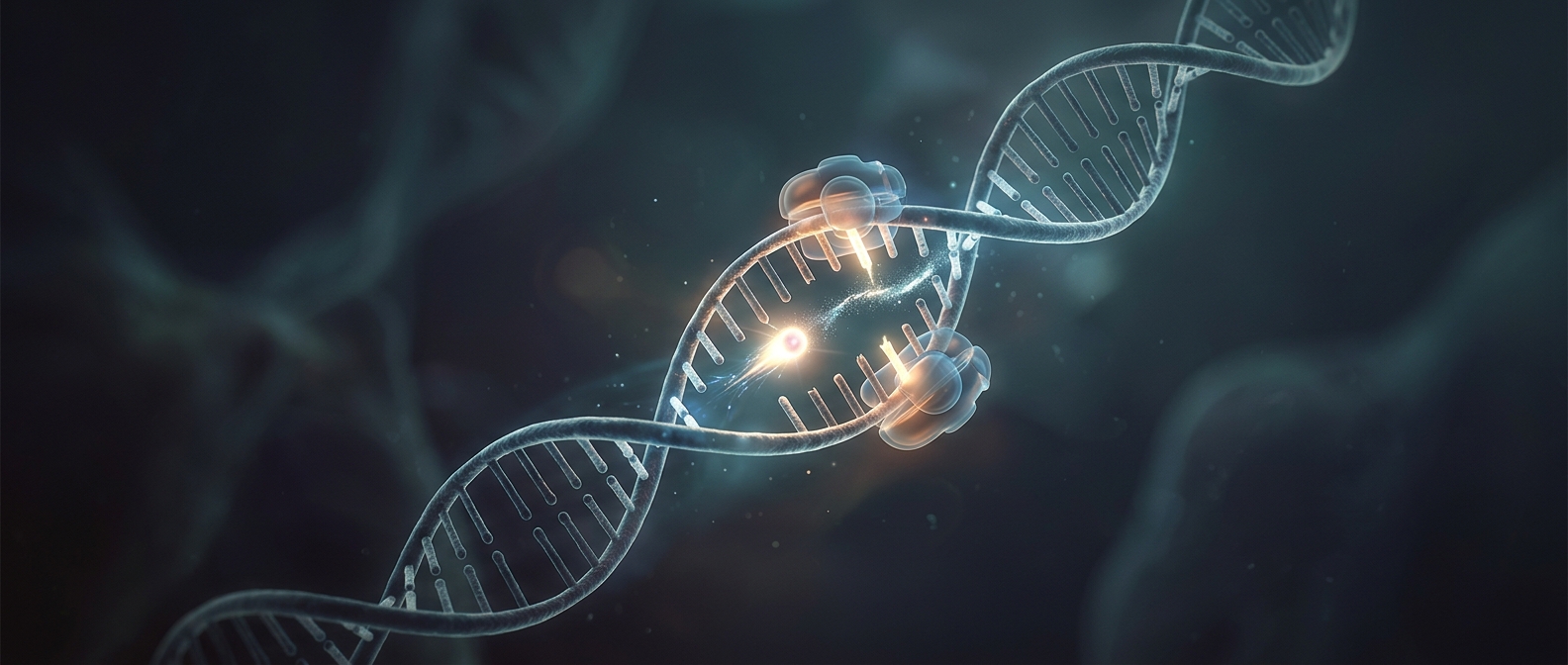
How cytochrome c oxidase helps make usable energy
Cytochrome c oxidase is the final major enzyme in the mitochondrial chain that transfers electrons during cellular respiration. It passes electrons to oxygen, which combines with protons—positively charged hydrogen ions—to form water. The enzyme also moves protons across the inner mitochondrial membrane, helping build a gradient, or difference in concentration, that cells use to make ATP, their main energy-carrying molecule.
What tunneling means in this setting
A chemical reaction can require particles to cross an energy barrier. In the everyday, classical picture, they must have enough energy to get over it. In quantum mechanics, a particle also behaves like a wave, so there is a probability it will be found on the other side of a barrier even when classical physics says it lacks the energy to climb over.
That is quantum tunneling. It is not an atom vanishing at one point and reappearing at another. In biological reactions, the relevant transfer may involve an electron or a proton, rather than an intact hydrogen atom. Enzymes can bring the reacting groups close together and arrange their surroundings in ways that make transfers more likely.
Why the distinction matters
Cytochrome c oxidase must coordinate electron and proton transfers to reduce oxygen safely and keep the membrane’s proton gradient going. Quantum effects can contribute to some enzyme reactions, but describing this enzyme as routinely teleporting hydrogen atoms—or saying tunneling alone keeps the heart beating—overstates what the mechanism means. The memorable point is subtler: cells use molecular arrangements where quantum-scale transfer can help chemical reactions proceed, while the enzyme’s larger job is to couple oxygen chemistry to the energy supply that powers ATP production.