Why a Fallen Leaf Can Become a Centerpiece
A dried leaf can serve as more than decoration: it can make an abstract idea—change, seasonal return, or the passage of time—visible in an everyday room. In personal spiritual practice, people may keep natural objects because they connect a space or moment with a meaning they have chosen. The leaf itself does not need to be credited with supernatural power; its role can be symbolic and personal.
From Perishable to Preserved
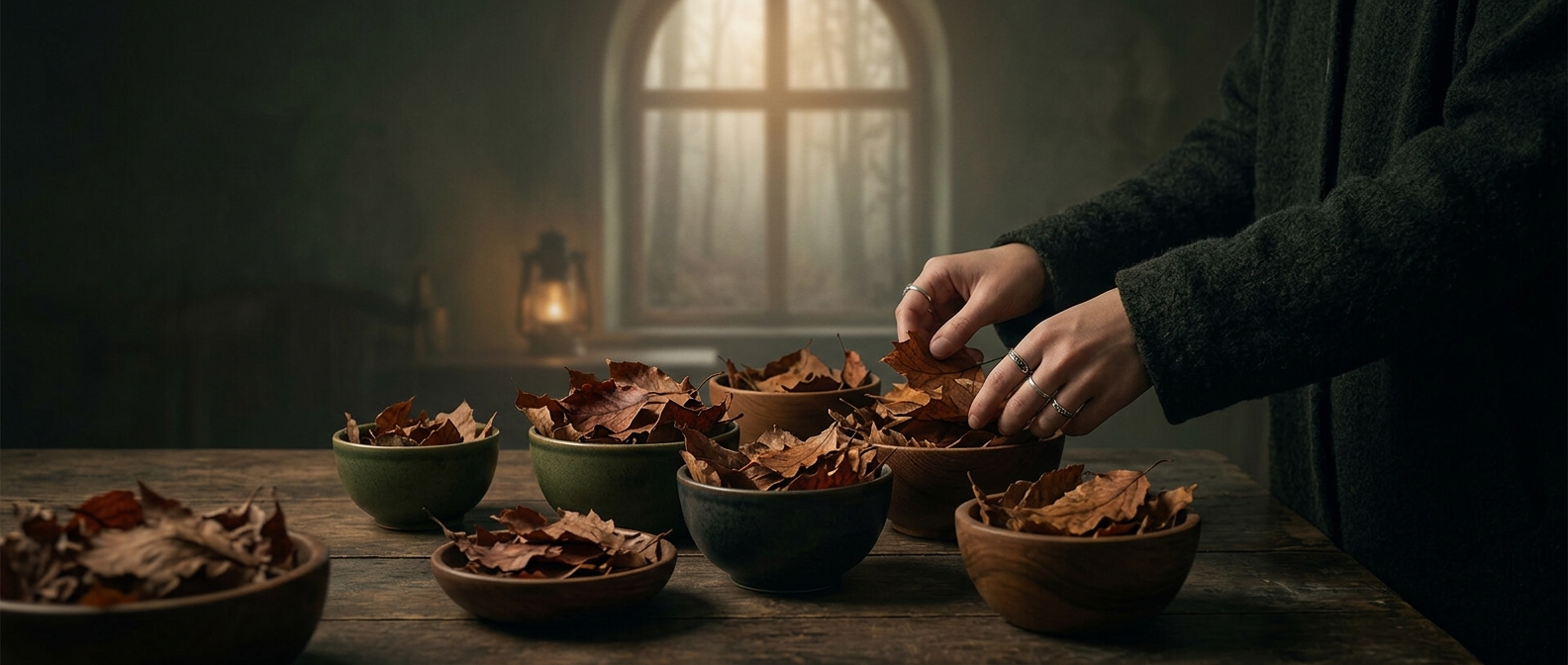
The choice to keep a brittle leaf turns an ordinary act of clearing away into an act of attention. A bowl gives fragile leaves a defined place, where they can be noticed rather than scattered or swept up. That arrangement can function as a small ritual cue: seeing it may prompt a pause, a memory, or a moment of reflection.
Dried leaves are also easily damaged by handling, moisture, and sunlight. Collectors therefore face a practical tradeoff: displaying them makes the objects meaningful and visible, but also exposes them to wear. Their fragility is part of the appeal and part of the care they require.
Meaning Depends on the Keeper
There is no single meaning attached to every dried leaf. One person may value a leaf for its color or shape; another may associate it with a season, a place, or a private experience. The bowl’s significance comes from that relationship—not from a universal rule about what leaves represent. In this way, a simple natural object can become a quiet marker of what someone chooses to remember.