A puffball changes from solid to spore chamber
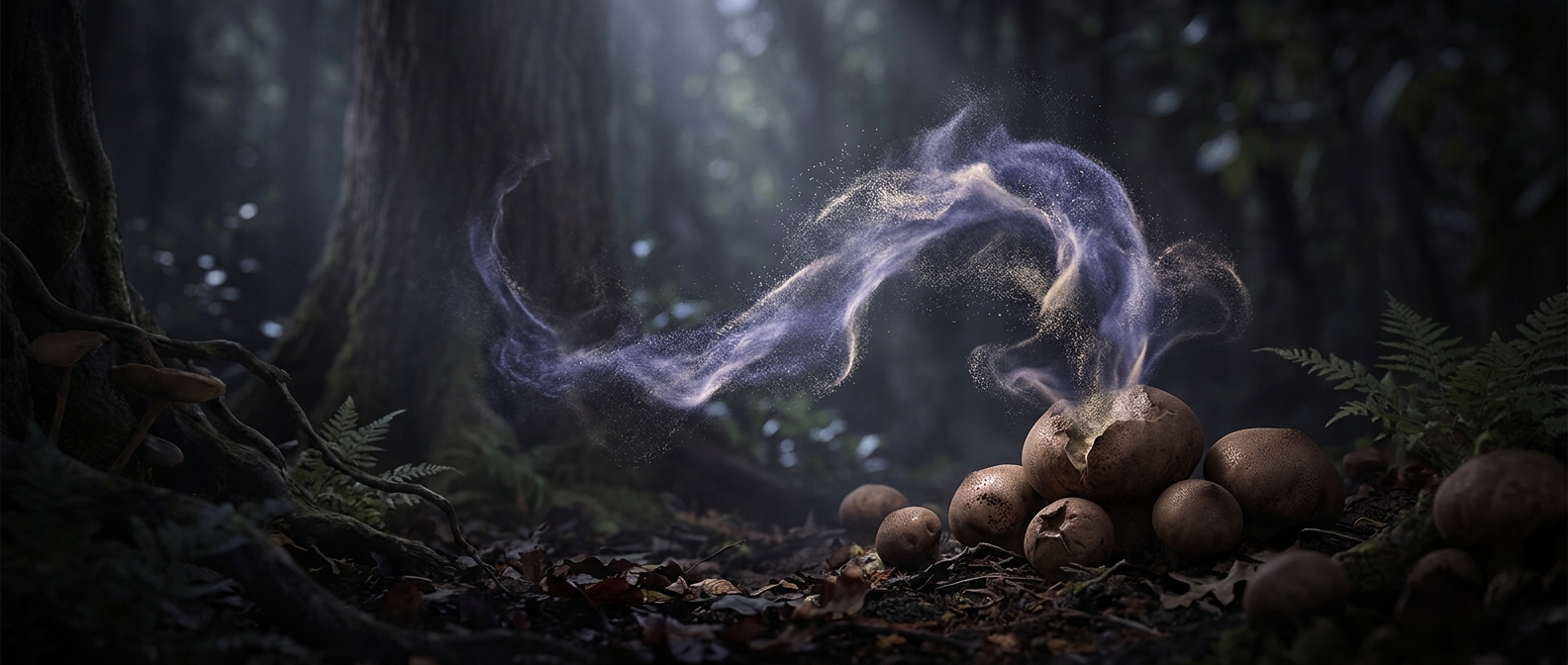
A young puffball is not yet a bag of loose spores. As it matures, the firm tissue inside—the gleba—breaks down into a dry, powdery mass containing millions of microscopic reproductive cells. The outer skin stays intact long enough to protect that material while it develops. Near maturity, a small opening forms at the top.
That opening gives the spores an exit, but it does not make them all drift away at once. The puffball’s shape and flexible walls turn a physical jolt into a brief burst of airflow.
Each impact pushes air through the opening
When a raindrop strikes or an animal brushes the mushroom, the wall bends inward. The sudden squeeze reduces the space inside and forces air through the opening, carrying a little cloud of spores with it. This is a form of ballistospory—spore release driven by a mechanical force—though the spores themselves are not launched like pellets by a spring.
A puffball can release spores in repeated small bursts as impacts continue. That matters because a single release would leave the spores close together, while separate puffs give moving air more chances to spread them in different directions. Once airborne, the spores may travel beyond the sheltered patch beneath the mushroom.
The burst is only the first step
A spore is not a miniature mushroom ready to grow anywhere. It must land in a suitable place and encounter the conditions needed to germinate; most spores will not. The puffball’s impact-triggered release is a way to distribute a huge number of chances across the surrounding landscape. A raindrop’s brief dent in the mushroom can therefore set a tiny, invisible cloud moving well beyond the spot where it formed.