A stage that turned the scenery into action
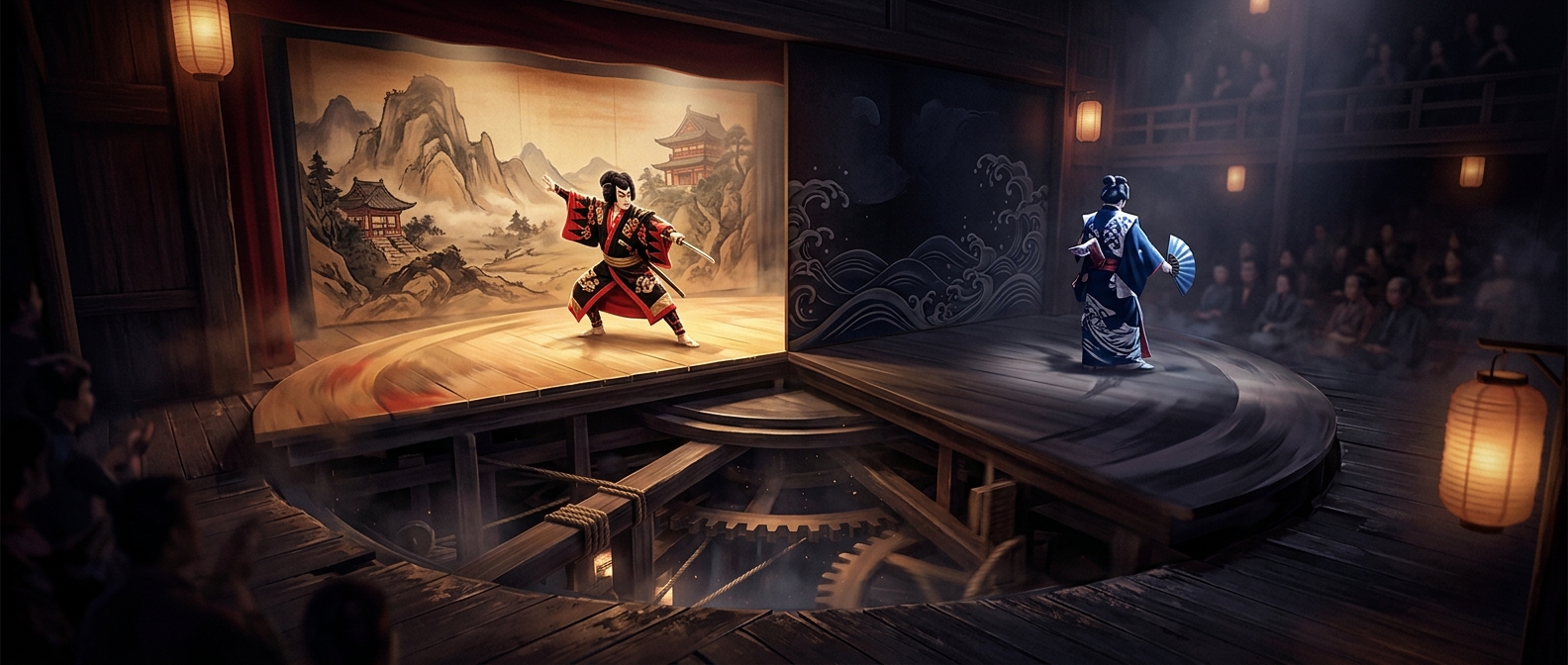
A revolving Kabuki stage—known as a mawari-butai—changed what a scene shift could look like. Instead of dropping a curtain while workers cleared one set and built another, the theater could rotate part of the floor. One arrangement of scenery turned out of view as the next came into sight, letting the story continue with little interruption.
The platform was built into the stage floor and turned by hand from below. Stagehands worked in the space underneath, often out of the audience’s view. Their job was not merely to move scenery: a carefully timed rotation could reveal a new place, redirect the audience’s attention, or carry a dramatic transition through the turn itself.
Why the mechanism suited Kabuki
Kabuki performances prize visible theatricality. Elaborate costumes, expressive movement, and bold stage effects are part of the event, rather than things to conceal in pursuit of realism. A revolving floor fit that approach: the machinery could make a change feel like a theatrical flourish, while the actors and musicians helped sustain the scene’s momentum.
The device also solved a practical problem. Large sets take time to rearrange, but a rotating platform can bring prepared scenery into position in one coordinated movement. That made swift changes between locations possible without requiring the audience to wait through a full backstage reset.
A change of scene, performed live
The turn depended on human coordination. Workers below had to move the platform while performers above maintained the rhythm and focus of the scene. The result joined engineering to performance: the stage itself became a moving part of the action. A scene change was no longer just the interval between two moments; it could be a moment the audience watched unfold.