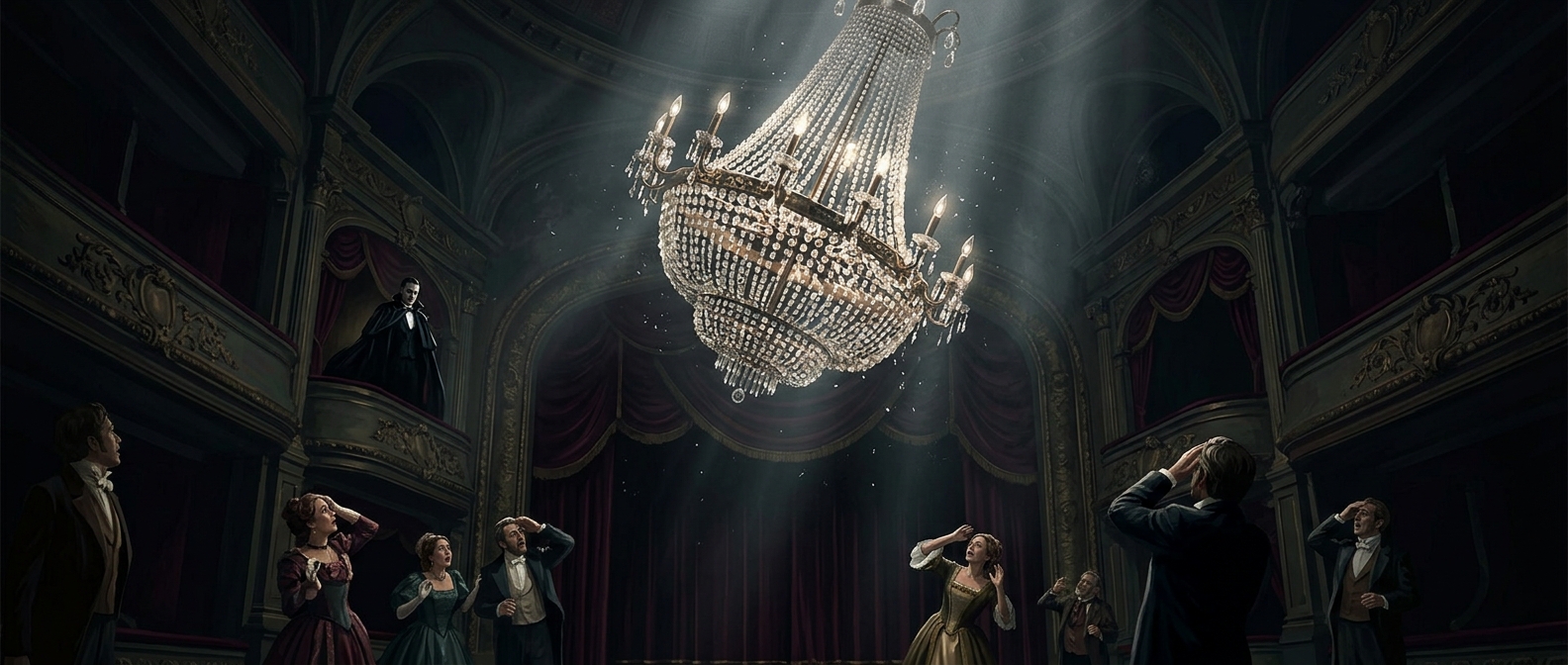
A Chandelier Built for the Illusion
In The Phantom of the Opera, the chandelier’s plunge works because the threat is a physical object moving through real space. It is not merely an image projected above the stage: a chandelier-shaped piece of scenery is suspended over the auditorium and made to descend as the music surges. That gives the moment weight and scale that a lighting effect alone could not provide.
Controlled Motion, Carefully Framed
The chandelier hangs from theatrical rigging—the cables and lifting equipment used to move scenery above a stage. Operators can lower it along a planned path while the production coordinates the movement with music, lighting, and sound. From the audience, the sudden descent reads as a loss of control; backstage, it has to be controlled closely enough to stop at its intended point.
The effect also depends on perspective. The chandelier does not need to crash into anyone to feel dangerous. Its size, height, speed, and position above the crowd make the audience part of the image, while the stage action gives the fall dramatic meaning. A musical crescendo helps focus attention at precisely the moment the object moves.
Why the Real Object Matters
A physical chandelier casts light and occupies space, so it can be seen from different seats rather than only from one camera angle. That makes the stunt a practical engineering problem as well as a theatrical one: the rig must support the object, move it reliably, and keep its path clear. The audience sees a moment of chaos, but its force comes from the precision required to make that chaos repeat night after night.