Why a Deck’s Possible Orders Grow So Quickly
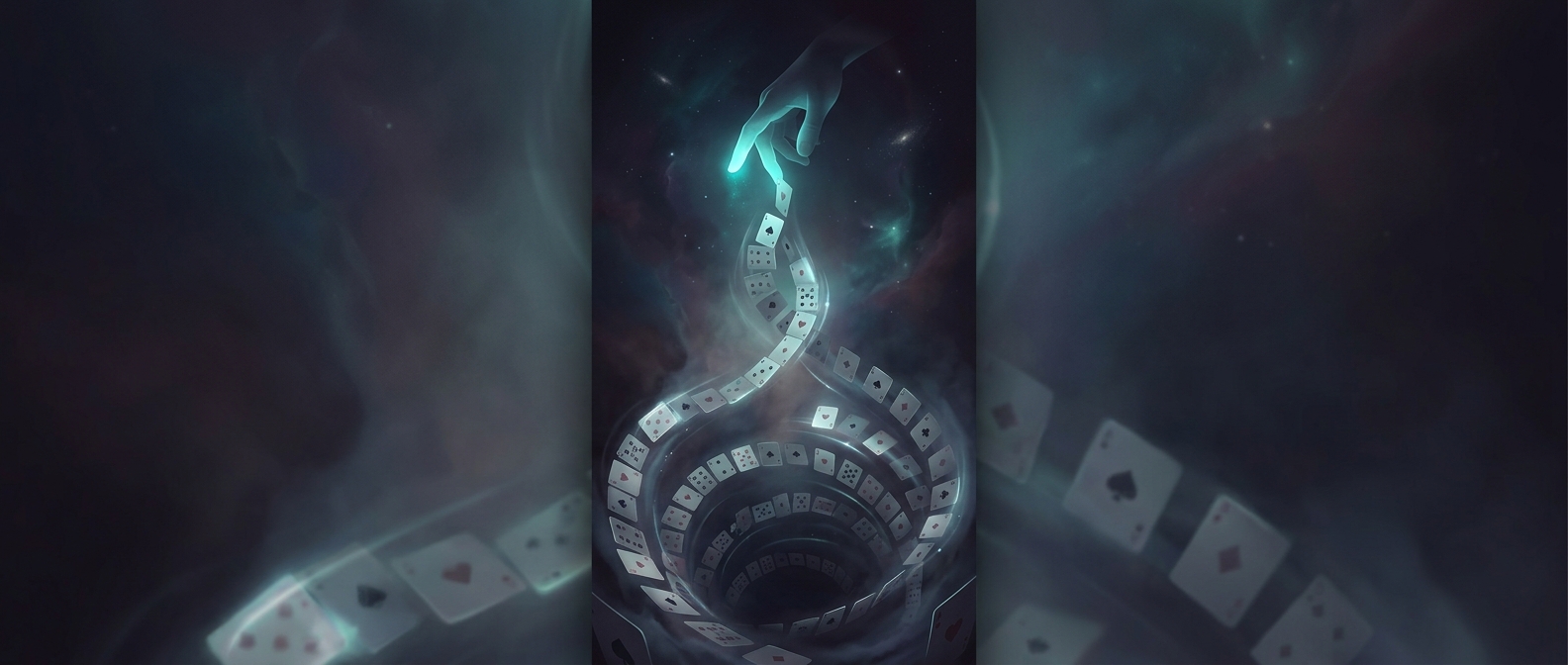
A standard deck has 52 distinct cards, and an arrangement counts as different whenever even one card occupies a different position. To count the possibilities, there are 52 choices for the first card, 51 for the second, 50 for the third, and so on. Multiplying those choices gives 52!—52 factorial, or roughly 8 followed by 67 zeroes.
The number grows so fast because every new card must be placed among the remaining positions. The deck is not merely being rearranged in a handful of broad patterns; it can have an enormous number of precise sequences.
What That Means at the Card Table
Imagine an ideal shuffle that produces each possible order with equal likelihood. The chance that it lands on one particular order is 1 in 52!. Even if a person could shuffle once every second for the entire age of the universe, the total number of shuffles would still be negligible beside that count.
This does not mean every real shuffle is perfectly random. Technique can leave cards more or less mixed. But after a thorough shuffle, the sheer size of the possibility space helps explain why the resulting order is overwhelmingly likely to be one that has never appeared before.
That is the quiet surprise of an ordinary deck: dealing the same familiar cards can produce a sequence so unusual that its exact order is effectively a one-time event.