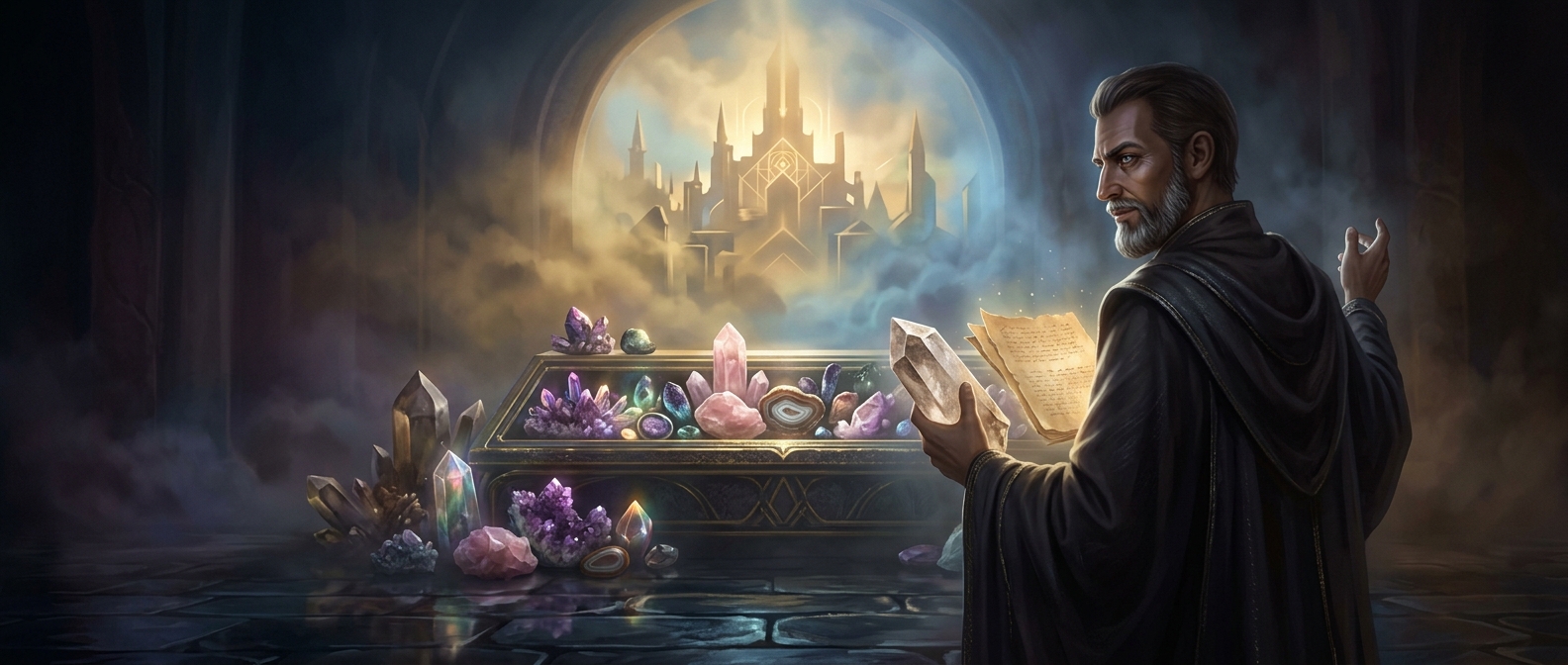
How a Lost-Continent Story Gave Crystals a Mystical Past
Frederick Spencer Oliver’s A Dweller on Two Planets presented itself not as ordinary fiction but as a message received from a spirit named Phylos. Oliver said the account had been telepathically communicated to him at Mount Shasta. Published after his death, the book described an ancient world of advanced spiritual knowledge and powerful crystals.
That framing did more than give crystals a fantastical setting. It cast them as remnants of a civilization that supposedly understood forces modern people had forgotten. A stone could therefore be imagined not merely as beautiful, but as a surviving instrument of hidden power.
From a Scientific Hypothesis to Occult Lore
The name Lemuria had a separate beginning. In the 19th century, zoologist Philip Sclater proposed a hypothetical lost land to explain the distribution of lemurs. Later writers adopted the idea as a vanished continent, giving it increasingly elaborate spiritual histories. Oliver’s book helped carry that transformation into popular mystical storytelling.
The distinction matters: the original scientific proposal was speculation about geography, while the spiritual Lemuria was a story about ancient wisdom. In that story, crystals offered a tangible link to an otherwise unreachable past.
Why the Link Endured
Crystal-healing traditions could draw on this narrative without requiring readers to know its literary history. The basic idea was easy to pass along: if an advanced lost civilization had used crystals, then crystals might still hold powers worth recovering. That made a small, familiar object feel like evidence of a much larger hidden world.
Oliver’s account did not establish that crystals heal illness. Its influence was cultural: it helped give crystal mysticism a memorable origin story, one that connected a stone in someone’s hand to the imagined technology of a lost civilization.