How a Quartz Claim Borrowed the Language of Computing
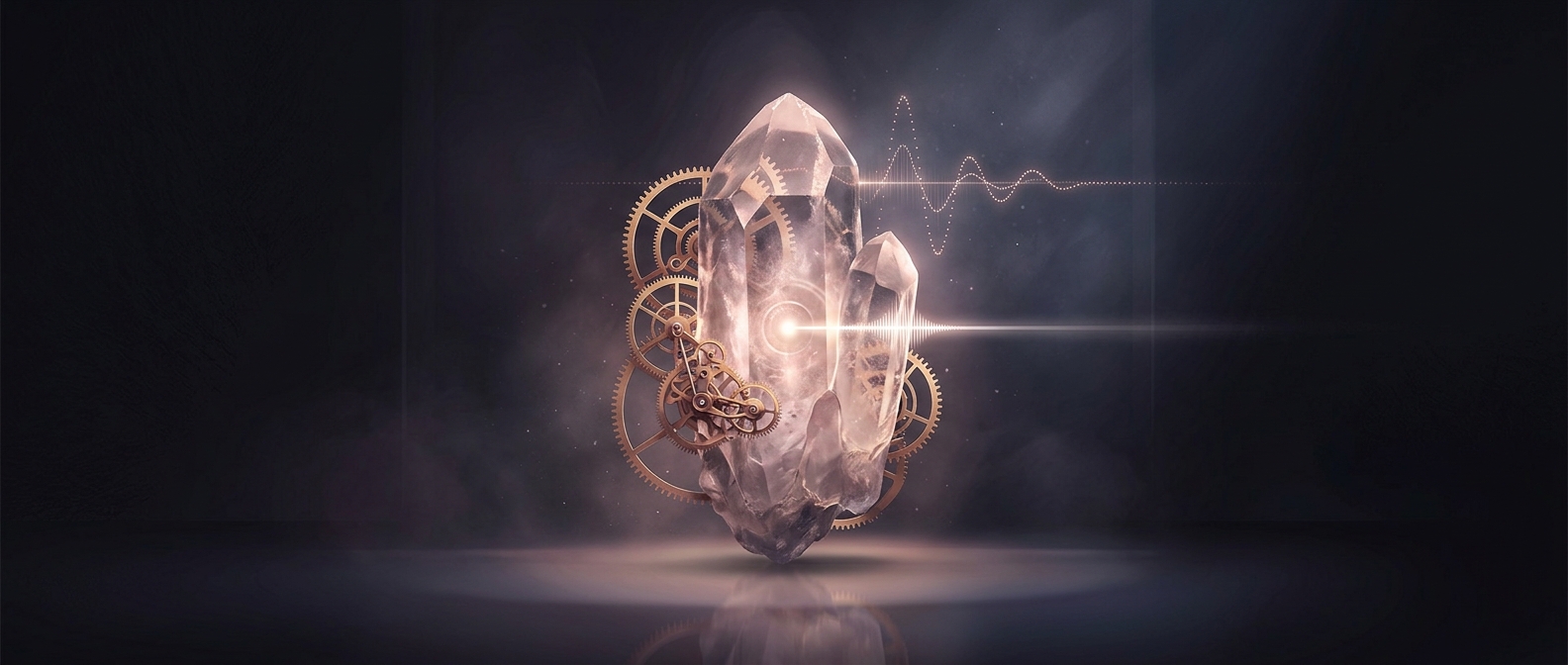
In the 1970s, Marcel Vogel argued that cut quartz could receive, amplify, and transmit human consciousness. His earlier work on magnetic disk drives at IBM gave the idea an arresting comparison: a crystal, he suggested, might handle thoughts as a drive handles data. That analogy made an unfamiliar spiritual claim sound like a new kind of information technology.
The comparison was metaphorical, not a description of how a disk drive works. A drive stores data through controlled physical changes in a material, which can later be read by a machine. Vogel’s claim treated consciousness as something a crystal could take in and pass along, but it did not establish a corresponding process by which thoughts were encoded in quartz.
What Quartz Can—and Cannot—Do
Quartz does have measurable physical properties. It is piezoelectric: pressure on the crystal can produce an electrical charge, and an applied voltage can make it vibrate. That behavior makes quartz useful in devices that need stable vibrations, such as clocks and electronic circuits.
But a material’s ability to respond to pressure or electricity is not evidence that it records thoughts. The key leap in Vogel’s account was from a real, useful property of quartz to a much broader claim about consciousness. The technical vocabulary helped make that leap feel plausible, even though the two ideas describe different kinds of processes.
Why the Story Endured
Vogel’s background offered crystal healing a bridge between spiritual practice and scientific-sounding explanation. The result was a memorable image: a crystal as a medium for human intention, rather than simply a stone used in a ritual. That image remains a powerful part of crystal-healing culture—but the drive analogy describes Vogel’s belief, not a demonstrated function of quartz.