Two Different Stories Told About Quartz
Quartz’s reputation in crystal healing and its role in watches come from different kinds of meaning. In crystal-healing traditions, people treat stones as objects with symbolic or spiritual qualities. Quartz is often valued within those beliefs, but its place in them is not a consequence of its use in electronics.
The connection can seem tempting: a watch crystal is associated with remarkable precision, so it is easy to imagine that the same property explains claims about healing. But a clock’s accuracy is a measurable physical effect; a crystal’s healing meaning belongs to a belief system. One does not establish the other.
What the Crystal Actually Does in a Watch
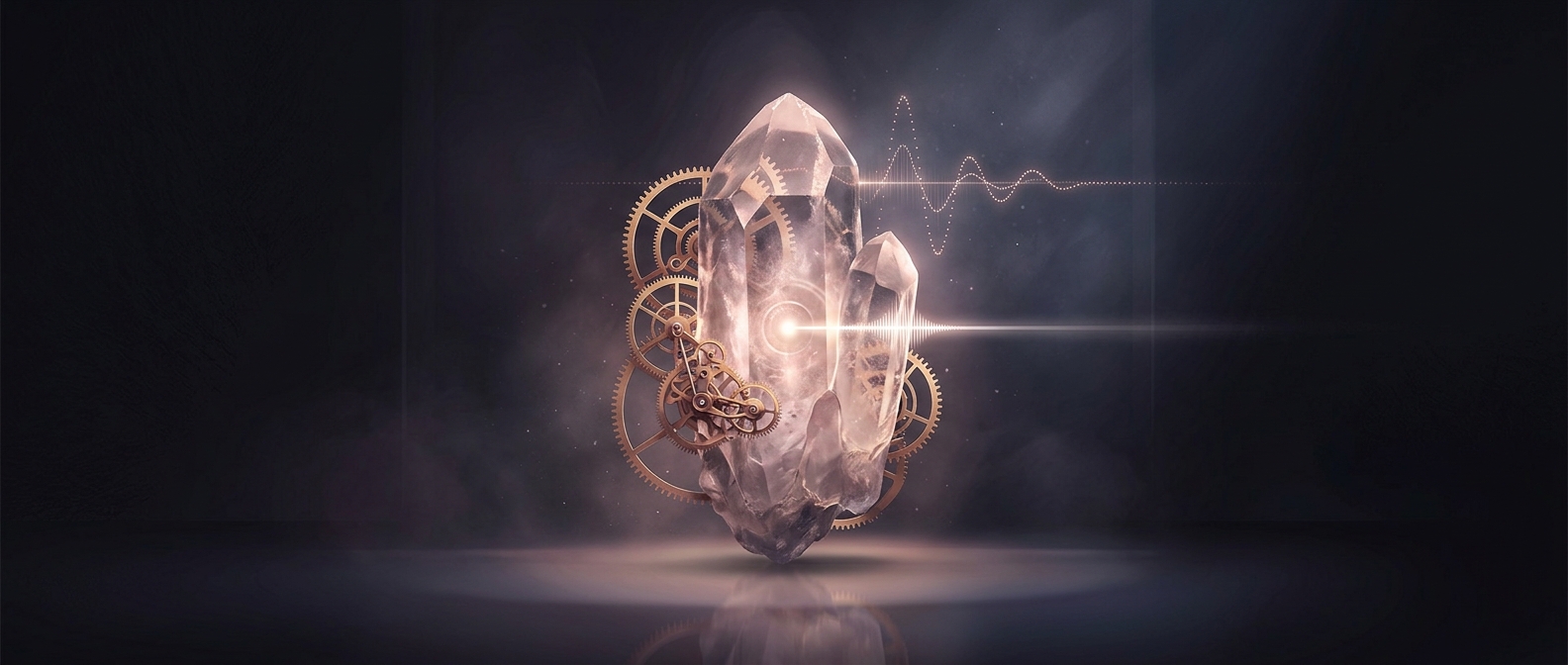
Quartz has a property called the piezoelectric effect: squeezing or bending it can produce a small electrical charge. The reverse also works—an electrical signal makes the crystal flex. In a quartz watch, a circuit drives the crystal into rapid vibration and counts those regular oscillations to keep time.
The crystal is not independently sensing time or directing energy into the wearer. Its usefulness comes from a repeatable response to an electrical signal, which a watch can turn into a steady timing reference. That practical behavior helps explain quartz’s technological importance, not why people assign it spiritual significance.
Keeping those explanations separate makes the fact more interesting, not less: the same mineral can be a precise component in one setting and a meaningful symbol in another, without the engineering function proving the spiritual claim.