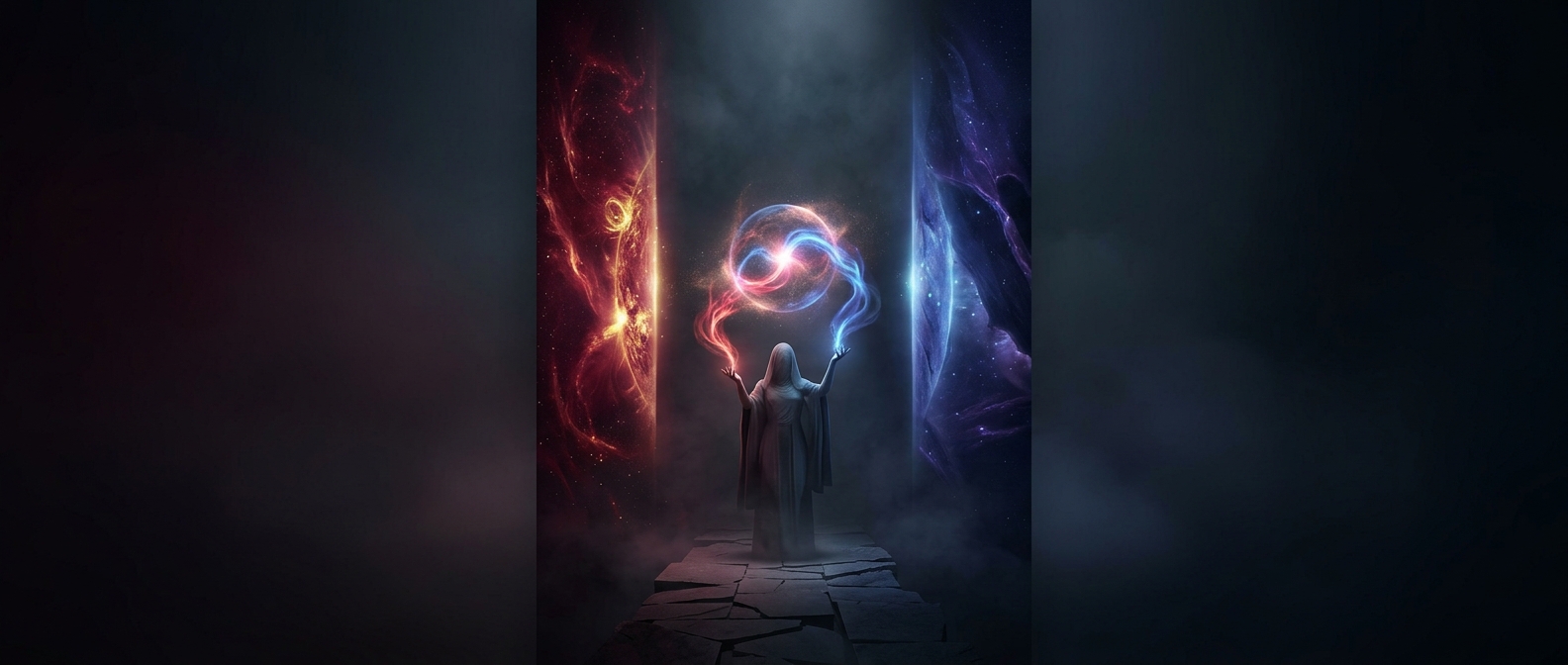
Why the second makes relation possible
A dyad is a pair: two distinct elements considered together. In philosophies that use unity and duality as symbols, the move from one to two is more than adding another item. It introduces difference. Once something can be distinguished from something else, there can be a relation between them—such as contrast, opposition, dependence, or exchange.
That is the sense in which the dyad makes “otherness” necessary. A solitary unity has no counterpart against which to define itself. With two terms, each can be understood partly through how it differs from or connects to the other.
From two points to a line
Geometry offers a concrete analogy: two distinct points determine a unique straight line. One point marks a position, but it cannot by itself specify a direction or span between positions. The second point makes that interval—and the relation of “between”—meaningful.
The analogy is symbolic, not proof that every kind of dimension literally arises from a philosophical split. Its force lies in showing how a pair can establish structure: difference gives us something to compare, and comparison gives us a relation.
The cost of becoming two
The dyad therefore carries a tension. It makes connection possible, but it also makes distinction possible: self and other, inside and outside, one side and another. In symbolic systems, those divisions may be treated as productive beginnings rather than errors to erase. The memorable implication is that relation requires more than a single presence: something must be distinct before it can stand in relation to something else.